
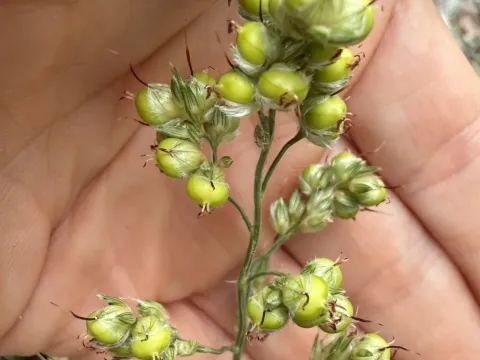
Sudan grass
Sorghum bicolor (L.) Moench subsp. bicolor
Sudan grass is a warm-season crop that requires soil temperatures of at least 12–15°C to germinate uniformly and ensure rapid establishment.
What the section contains
Sudan grass
Sowing typically takes place in late spring, once the threat of frost has completely passed and the soil has warmed up sufficiently for vigorous growth.
To ensure a continuous supply of green forage throughout the summer, farmers often stagger plantings in several phases spaced two to three weeks apart.
Seeds should be drilled at a depth of 3 to 5 centimeters, depending on soil moisture levels, to ensure good contact and protect them from drying out.
Row spacing can vary from 15 to 45 cm, with tighter spacing often preferred to outcompete weeds and maximize the density of the forage canopy.
This crop is exceptionally well-adapted to hot and arid climates, relying on its deep and extensive root system to extract water from deeper soil horizons.
Sudan grass is relatively versatile regarding soil types, though it thrives best on well-drained, fertile loams that offer good aeration for root health.
Abundant sunlight is a primary requirement for the plant to achieve its potential for biomass production and to maintain its high sugar content.
Nitrogen fertilization is essential for high yields, especially if the crop is being harvested multiple times during the season for regrowth.
While tolerant of some soil conditions, the plant does not perform well in poorly drained or waterlogged soils, which can stunt development and promote disease.
Sudan grass is renowned for its rapid regrowth capability, allowing for multiple harvests within a single growing season under optimal management.
In well-watered or irrigated conditions, the total annual green mass yield can range from 40 to 80 tonnes per hectare depending on the harvest frequency.
The biomass quality is highest when harvested at the boot or early heading stage, balancing the total volume with the concentration of digestible nutrients.
Dry hay production yields typically vary between 8 and 15 tonnes per hectare, depending on the fertility of the soil and the timing of the seasonal cuts.
Effective management of fertilization and irrigation can lead to significant increases in biomass output, making it one of the most productive annual fodder crops.
The crop can be susceptible to various fungal diseases, including head smut and leaf blight, particularly under conditions of high humidity and poor ventilation.
Aphids represent the most significant insect threat, capable of rapid population growth that causes leaf yellowing and reduced forage palatability.
The European corn borer may tunnel into stems, causing structural weakness and increasing the susceptibility of the plant to secondary bacterial infections.
Seed treatments with fungicides are standard practice to protect the crop during the vulnerable seedling stage against soil-borne pathogens.
Integrated pest management strategies, such as maintaining proper plant spacing and monitoring for early pest presence, are crucial for minimizing chemical usage.
For fresh grazing or green chop, harvesting should begin before the plants reach the flowering stage to maintain the best protein-to-fiber ratio.
When cutting for hay, it is important to allow the material to dry effectively in windrows to prevent mold growth and maintain nutritional quality during storage.
Maintaining a stubble height of at least 10 cm during mechanical harvesting is vital for stimulating secondary growth and protecting the crown of the plants.
The use of conditioners during the cutting process helps crush the stems, which significantly speeds up the drying process and improves overall feed quality.
Harvesting should be completed before the first heavy frost to ensure the plants remain safe for livestock consumption and to protect the soil for the next cycle.