

Reference · Crops
Sorghum
Sorghum Moench
Sorghum is a thermophilic crop, meaning it should be planted only when the soil temperature at the planting depth reaches at least 12–14 degrees Celsius.
6
items
What the section contains
 Sorghum
 bicolor (L.) Moench
634 products
Sorghum
Sorghum bicolor (L.) Moench
634 products
 Sudan grass
Sorghum x drummondii (Steud.) Millsp. & Chase
53 products
Sudan grass
Sorghum x drummondii (Steud.) Millsp. & Chase
53 products
 Johnsongrass
Sorghum halepense (L.) Pers.
12 products
Derzhavin sorghum
Sorghum xderzhavinii Tzvel.
Sorghum almum
Sorghum x almum Parodi
Sudan grass
Sorghum bicolor (L.) Moench subsp. bicolor
Johnsongrass
Sorghum halepense (L.) Pers.
12 products
Derzhavin sorghum
Sorghum xderzhavinii Tzvel.
Sorghum almum
Sorghum x almum Parodi
Sudan grass
Sorghum bicolor (L.) Moench subsp. bicolor
Marketplace
Products in this section · 12


Sorghum
The optimal sowing window typically falls in late spring, ensuring that the soil is sufficiently warm to support rapid and uniform germination.
Seeds are usually sown at a depth of 3 to 5 centimeters, depending on soil moisture levels and the texture of the seedbed.
Proper plant population density is crucial, as it varies based on whether the crop is being grown for grain production or forage usage.
Uniformity during the sowing process prevents gaps in the field, which allows the crop to better compete against emerging weeds.
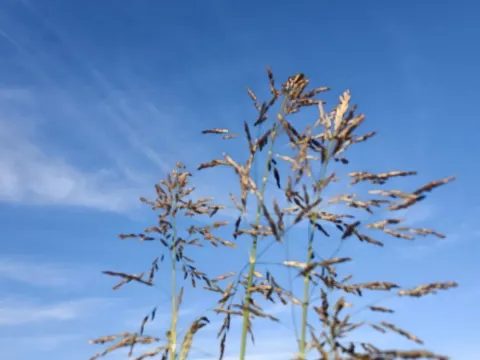
Sorghum, a member of the Poaceae family, is renowned for its exceptional drought tolerance and ability to thrive in harsh environments.
The plant features a highly developed root system that allows it to access deep soil moisture during periods of low rainfall.
It performs exceptionally well in regions with high solar radiation and high temperatures, which are essential for its metabolic processes.
While the crop is adaptable to various soil types, it performs best in fertile soils with good drainage and a balanced pH range.
Early-season weed control is critical because sorghum seedlings develop slowly and can be easily suppressed by fast-growing competitors.
Grain yields for modern sorghum hybrids can range from 6 to 8 tons per hectare when grown under optimal agronomic management.
When cultivated for forage or silage, sorghum provides a massive biomass yield that frequently exceeds 40 to 60 tons per hectare.
Yield stability is a major benefit of the crop, as it continues to produce reliably even in years when other grains suffer from heat stress.
Nutrient management, specifically nitrogen and phosphorus application, plays a pivotal role in maximizing both grain and fodder output.
Genetic potential, combined with the mitigation of water stress, ensures that sorghum remains a high-yielding option for dryland farmers.
Sorghum crops are susceptible to various diseases, including smut, Fusarium stalk rot, and several bacterial leaf blights that impact foliage health.
Pest management is focused on common threats such as the sorghum midge, aphids, and corn earworm, which can cause significant damage to heads.
Integrated pest management strategies are recommended to reduce the reliance on chemical sprays while maintaining effective control levels.
Seed treatments are an essential preventative measure, ensuring that the plants are protected during the vulnerable germination stage.
- Regular scouting
- Use of resistant hybrids
- Proper crop rotation
- Biological control agents
- Weed management
Harvesting grain sorghum typically involves direct combining once the seed moisture levels have dropped to an acceptable level for storage.
Desiccation is a common practice used to ensure uniform drying of the grain heads, especially in areas with unpredictable late-season weather.
For forage production, harvesting is performed at the soft dough stage to capture the highest nutrient concentration before the stalks lignify.
Post-harvest storage requires careful moisture monitoring to prevent mold development and ensure the long-term quality of the grain.
Timely harvest is essential to minimize losses from shattering, which can occur if the mature crop remains in the field for too long.