
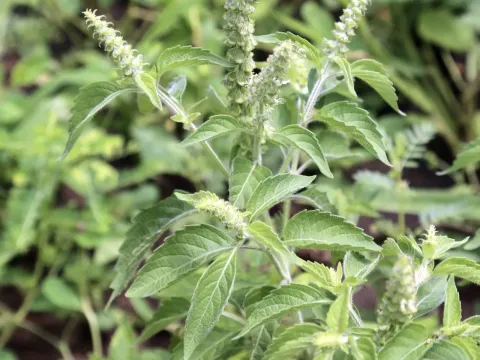
Green basil
Ocimum viride
Green basil is a heat-loving crop, so its sowing time is strictly tied to soil temperature. Seeds are sown in open ground only after stable warm weather has set in, when the soil warms up to 15-18 degrees Celsius.
What the section contains
Green basil
For earlier commercial production in temperate climates, the seedling method is recommended. Seeds are sown in trays in March or April, 40-50 days before the expected planting date in the permanent field.
The sowing depth for seeds should not exceed 0.5–1 centimeter. It is crucial to ensure high substrate moisture and an air temperature of at least 20-22 degrees to ensure uniform germination.
When sowing directly into the soil, it is important to follow a planting pattern that ensures proper air circulation. The recommended distance between rows is 30–40 centimeters, and between plants in a row — about 20–25 centimeters.
After the first true leaves appear, thinning is carried out if the sowing was dense. This is necessary to prevent the plants from stretching and to ensure they receive sufficient light.
The crop has high light requirements. For the full accumulation of essential oils, which determine the spicy aroma and health benefits of basil, the plant requires intense sunlight throughout the entire daylight hours.
The soil should be light, fertile, and well-aerated. Heavy clay soils are poorly suited for growing this crop, as they retain excess moisture, which leads to root system rot.
The soil pH should be close to neutral, in the range of 6.0–7.0. In acidic soils, the growth of basil slows down, and the leaf blade may lose its characteristic deep green color.
Basil is sensitive to moisture deficit, especially during the active vegetative growth phase. Watering should be regular but moderate to avoid water stagnation, which triggers the development of fungal diseases.
An important factor for success is protection from strong winds and drafts. The plant prefers well-warmed, sheltered areas where a specific microclimate is created, contributing to rapid accumulation of green mass.
The average yield of green basil depends directly on the intensity of agrotechnical measures and soil fertility. On average, 1 to 2 kilograms of fresh herbs can be harvested per square meter per season.
Maximum productivity is achieved through multiple cuts of lateral shoots. As the plant grows, the tops are pinched, which stimulates branching and allows for a significant increase in the total biomass of the plant.
It is important to monitor the developmental phase of the plant: the highest concentration of nutrients and essential oils occurs in the period before budding. After flowering begins, leaf growth slows down, and their taste qualities decrease.
In commercial production, intensive technologies are used, including drip irrigation and regular fertilization with complex fertilizers. This allows for up to 3-4 harvests of green mass per full growing season.
Proper drying or freezing after harvesting allows for the preservation of the commercial properties of the crop for further use in cooking or pharmacology, which is an important economic indicator for the crop.
One of the most dangerous diseases for basil is damping-off, which affects young seedlings during high humidity and low air temperatures. Prevention consists of maintaining proper watering regimes and soil disinfection.
Fusarium wilt also poses a serious threat to plantations. The disease manifests as darkening of the stem vessels and subsequent wilting of leaves, occurring most often with prolonged violation of crop rotation.
Among pests on basil plantations, aphids and spider mites are most commonly encountered. These insects feed on the plant's cell sap, leading to leaf deformation and a significant decrease in the yield of marketable greens.
For pest control, it is preferable to use biological agents or infusions of insecticidal plants, as basil is a food crop that requires safe processing methods without the use of harsh chemicals.
Adherence to crop rotation rules is the best method to prevent the accumulation of pathogens in the soil. It is not recommended to plant basil in the same place for more than two years in a row, or after other members of the Lamiaceae family.
Basil harvest begins when plants reach a height of 15-20 centimeters. The first cut is made by leaving the lower part of the stem with several leaves for further growth of lateral shoots.
Harvesting is best done in the morning hours, after the dew has evaporated but before the midday heat. At this time, the concentration of essential oils in the leaves reaches its maximum, ensuring the best aroma.
For fresh consumption, greens are cut in bunches or as individual leaves. If preparing for winter, harvesting is carried out by mowing the entire above-ground part of the plant before the flowering stage.
After cutting, the greens should be cooled or processed as quickly as possible. Freshly cut basil does not tolerate long storage at room temperature, as the leaves quickly lose turgor and darken.
In professional production, harvesting is carried out mechanically or manually using sharp tools to avoid crushing the stem tissues, through which infections can penetrate.