
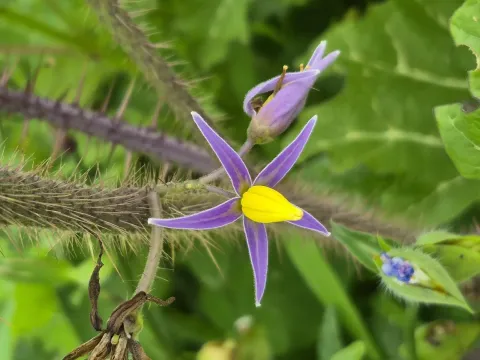
Solanum palinacanthum
Solanum palinacanthum
Solanum palinacanthum is a perennial plant belonging to the Solanaceae family. Native to South America, including countries like Brazil and Paraguay, this species is well-known for its invasive nature and ability to colonize disturbed habitats, pastures, and roadsides throughout its range.
What the section contains
Solanum palinacanthum
The plant is distinguished by its formidable physical defense mechanism: sharp, rigid spines covering both its stems and leaves. This morphological feature not only deters herbivores but also facilitates its expansion into degraded lands where competition for resources can be intense.
Regarding soil requirements, Solanum palinacanthum is highly adaptable. It can thrive in a variety of soil types, ranging from nutrient-poor to compacted or degraded substrates, allowing it to quickly dominate neglected agricultural areas or overgrazed lands.
Climatic preferences include high levels of solar radiation and moderate to warm temperatures. It is sensitive to frost and lacks cold tolerance, which limits its distribution to warmer, frost-free regions. Adequate drainage is essential to prevent root rot in wetter seasons.
From an agricultural standpoint, the plant is primarily managed as a harmful weed. While some studies explore the secondary metabolites found in its tissues, the presence of alkaloids makes it potentially toxic to livestock, making it a target for chemical and mechanical control programs.
The species is susceptible to various fungal pathogens common to the Solanaceae family, including early blight and various leaf spot diseases. These threats are particularly prevalent during periods of high humidity and poor ventilation within the plant canopy.
In terms of insect threats, various coleopteran and dipteran species feed on the foliage and reproductive organs of Solanum palinacanthum. These organisms often serve as natural enemies that can significantly impact the plant's life cycle and seed production efficiency.