
European mistletoe
Viscum album
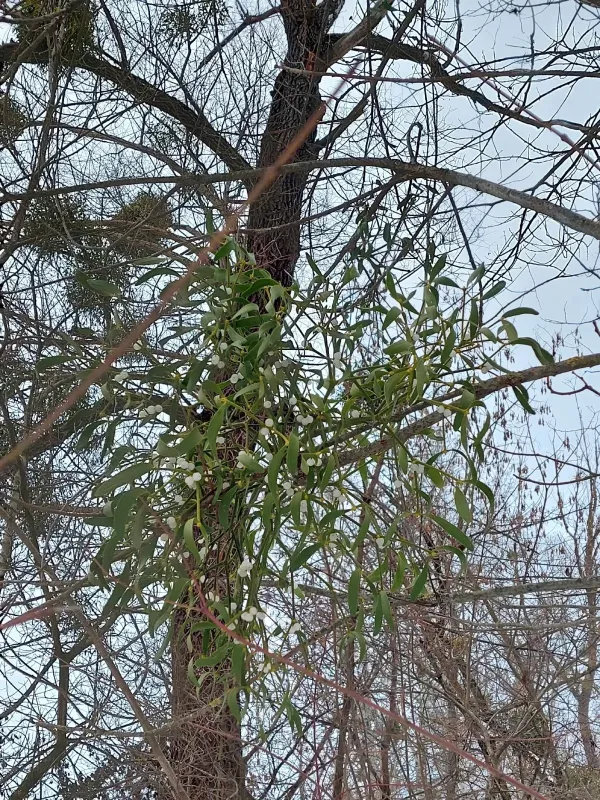
Description
Sowing dates
European mistletoe (Viscum album) is a distinctive hemiparasitic shrub belonging to the Santalaceae family, characterized by its evergreen leaves and white berries.
The plant does not require traditional sowing, as its life cycle relies on birds that ingest the berries and deposit the seeds onto tree branches.
The sticky pulp of the berries acts as a natural glue, securing the seed firmly against the bark of host trees such as apple, lime, or poplar.
Upon germination, the plant develops haustoria—specialized structures that penetrate the bark to extract water and mineral nutrients from the host.
Despite being a parasite, it performs photosynthesis independently due to its green leaves, which classifies it as a hemiparasite rather than a holoparasite.
Growing requirements
This species thrives in temperate climates across Europe and Asia, demonstrating a high tolerance for varying environmental conditions and seasonal shifts.
It has no specific soil requirements since it does not root in the ground, drawing all its essential resources directly from the host plant's vascular system.
Mistletoe prefers high light availability, which is why it predominantly occupies the upper canopy of old, wide-spaced trees or edges of forest clearings.
The plant's resilience allows it to remain physiologically active and green even during harsh winters, making it a key component of winter ecosystems.
In managed landscapes, it is often viewed as a pest that requires monitoring to prevent severe stress or premature decline of the host tree.
Yield
The yield of mistletoe is measured by the total biomass of shoots and leaves collected from infested trees, typically intended for pharmaceutical processing.
The economic value is driven by the presence of bioactive compounds, including lectins, viscotoxins, and alkaloids, which are extracted for medical research.
Yield stability is low, as it fluctuates based on the age of the host trees, their health status, and the local density of mistletoe populations.
Sustainability is a core concern, requiring harvesters to balance the collection of herbal raw material with the long-term health of the host trees.
Harvesting efficiency depends largely on the ease of access to the tree crowns and the scale of the mistletoe infestation on individual hosts.
Main diseases and pests
The primary concern regarding mistletoe is the physiological decline of the host tree, which may suffer from stunted growth and reduced vigor over time.
In forests and orchards, heavy infestation can lead to branch breakage and increased susceptibility of the host to secondary pathogens and climate stress.
Few natural pests attack the mistletoe itself, though some specific mites and insects utilize its structure for protection and as a food source.
Diseases affecting mistletoe are mainly fungal, often occurring due to localized high humidity and lack of ventilation at the site of attachment.
Management strategies involve selective removal of infected branches or the use of plant growth regulators to suppress the parasite's development.
Harvesting
Harvesting occurs predominantly in winter, as this is when the plant is most accessible and its concentration of bioactive compounds is considered optimal.
Professionals use specialized tools, such as telescopic pruners, to carefully remove the shoots while minimizing physical damage to the host's bark.
Post-harvest management involves rapid drying to maintain the structural integrity and chemical potency of the green biomass before degradation starts.
Proper drying must take place in climate-controlled environments to prevent the development of mold, which frequently occurs due to the high moisture content.
High-quality botanical material should be free from woody bark debris and signs of decay, ensuring its suitability for standardized pharmaceutical production.