
Viscum capitellatum
Viscum capitellatum
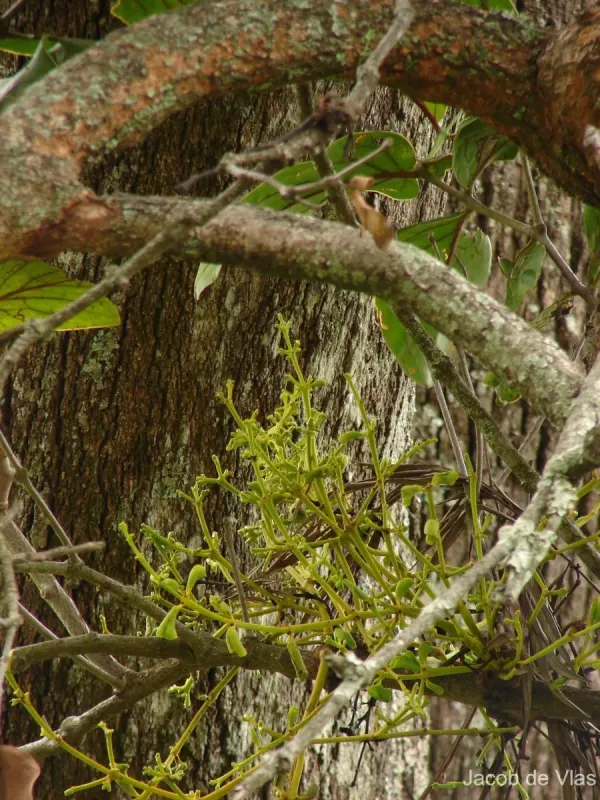
Description
Growing requirements
Viscum capitellatum is a distinct species of evergreen hemiparasitic plant belonging to the Santalaceae family. It predominantly inhabits the canopy of host trees in the tropical and subtropical regions of Asia, functioning as an epiphyte throughout its life cycle.
Botanically, this plant is characterized by its specialized haustoria, which allow it to penetrate the vascular system of the host tree to siphon essential water and nutrients. Unlike holoparasites, it retains chlorophyll and performs photosynthesis, classifying it as a hemiparasite.
The native distribution of the species is focused on forested areas where specific host trees of the Loranthaceae family are present. It thrives in high-humidity environments, which are essential for the germination of its seeds on the bark of host branches.
The plant requires stable temperature conditions and filtered sunlight, typically found in the upper layers of a forest canopy. Its growth is closely tied to the physiological health of the host, as the host provides the structural support and hydraulic base for the mistletoe.
It is not an agricultural crop in the conventional sense. Instead, it is recognized for its unique evolutionary adaptations and its role in the complex web of interactions within Asian forest biodiversity, often acting as a point of interest for botanical researchers.
Main diseases and pests
The primary threats to Viscum capitellatum involve the degradation of natural forest ecosystems and the removal of host trees. Habitat fragmentation significantly limits the ability of the plant to spread its seeds to new, suitable host locations.
Natural pests include various bird species that consume the fruits, as well as specific insects that feed on the succulent tissues of the mistletoe. Additionally, fungal pathogens can infect the stems during periods of high precipitation, affecting the overall vigor of the parasite.
Competition with other epiphytic plants for sunlight and resources from the host tree exerts a continuous pressure on the species. This ensures that the population of Viscum capitellatum remains in check within its native habitat.
Climate change, manifesting as altered precipitation patterns, represents a long-term risk. Since the germination process relies on precise moisture levels, any shift in seasonal humidity can drastically reduce the success rate of seedling establishment.
Monitoring the presence of Viscum capitellatum is crucial for ecological surveys, as it serves as a bio-indicator for the maturity and health of tropical forest tracts. Conservation efforts focus on protecting the overall integrity of the forest ecosystem.