
Viscum continuum
Viscum continuum
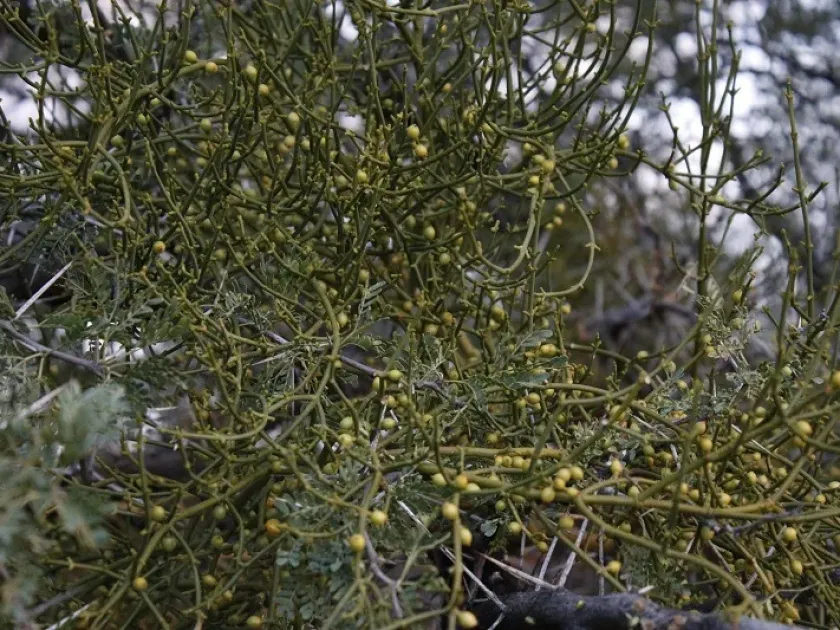
Description
Growing requirements
Viscum continuum is a perennial hemiparasitic plant belonging to the Santalaceae family. It is strictly epiphytic, meaning it spends its entire life cycle attached to the branches of host trees, from which it extracts essential water and minerals.
The plant originates from tropical and subtropical regions. Its distribution is closely linked to the presence of suitable host species within humid forest environments where constant moisture levels support the continuous metabolic activity of the parasite.
Botanically, it is defined as a hemiparasite because it possesses chlorophyll and can perform photosynthesis independently. However, it relies entirely on the host tree's vascular system, specifically the xylem, to secure the necessary water and nutrient supply for survival.
Environmental requirements are quite specific, focusing on high atmospheric humidity and relatively stable temperatures. The plant cannot tolerate arid conditions or extreme cold, which would interrupt the flow of sap from the host, leading to dehydration of the Viscum.
Regarding management, Viscum continuum is not cultivated in a traditional agricultural sense. Instead, forestry management often focuses on mitigating its spread when it affects the structural integrity or commercial viability of valuable host timber species.
Main diseases and pests
The primary threat to Viscum continuum populations is the decline of host tree health. If the host tree dies or sheds its bark significantly due to environmental stress or infection, the parasite loses its source of nourishment and water.
Fungal infections often target the site where the mistletoe's haustorium penetrates the tree bark. This reaction by the host, or the progression of the fungus, can successfully disconnect the parasite from the host's nutrient supply chain.
Various insect pests, including specific beetle larvae and caterpillars, have evolved to feed on the foliage of Viscum. While they rarely eradicate a population, their feeding habits can stunt the growth and reproductive capacity of the plants.
Bird populations play a dual role as both vectors for seed dispersal and major predators of the fruit. In some seasons, excessive predation on berries limits the plant's potential to establish new colonies on neighboring branches.
Human intervention, particularly through forest thinning and targeted removal of parasitic growths, remains the most significant threat in managed forest systems. Such practices are common in regions where the mistletoe is viewed as a threat to host vigor.