
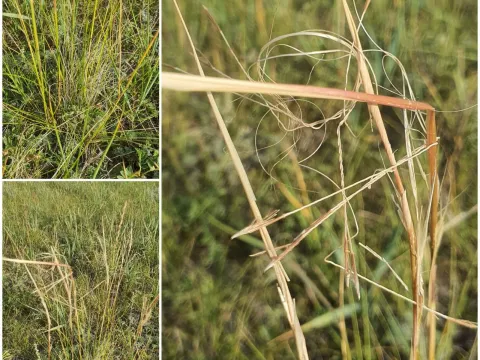
Krylov's Feather Grass
Stipa krylovii
Krylov's Feather Grass (Stipa krylovii) is a significant perennial species of the Poaceae family, widely recognized for its ecological importance in arid steppe regions.
What the section contains
Krylov's Feather Grass
The optimal sowing period is early spring, taking advantage of soil moisture reserves accumulated from snowmelt, which is vital for the germination of this species.
Late autumn or winter sowing is also a viable practice, allowing the seeds to undergo natural stratification, which often leads to more vigorous development in the following season.
Sowing should be performed at a shallow depth of approximately 1 to 2 centimeters; precise placement is essential to ensure consistent emergence of seedlings.
Post-sowing soil compaction is recommended to enhance the moisture contact between seeds and the soil matrix, facilitating a more uniform stand establishment.
This species is highly adapted to continental climates, characterized by extreme temperature fluctuations and limited annual precipitation throughout the growing cycle.
It thrives in well-drained soils, preferring loamy or sandy-loam textures that contain high carbonate levels, which are typical of its natural steppe habitat.
Krylov's Feather Grass is highly photophilous and requires full sun exposure; it does not tolerate shading from woody vegetation or denser crop canopies.
The plant demonstrates remarkable drought resistance, maintaining metabolic activity even during prolonged periods of high heat and moisture deficit in the mid-summer.
Excessive moisture or waterlogging is detrimental to the plant, as it leads to root asphyxiation and significantly increases the risk of soil-borne pathogens.
The biomass yield of Stipa krylovii is relatively modest compared to intensive forage crops, but it remains remarkably consistent under stress conditions where others fail.
Its primary agricultural value lies in its role as a permanent grazing component, as it withstands moderate grazing pressure and demonstrates high persistence in pastures.
Forage quality is highest during the vegetative stage before flowering; afterwards, the increase in crude fiber content reduces its nutritional value for livestock.
Effective pasture management includes rotational grazing schemes that allow the grass to recover, ensuring long-term sustainability and productivity of the sward.
Strategic management of stocking density is crucial; overgrazing significantly reduces the vigor of the plant and leaves the ground vulnerable to soil erosion.
Krylov's Feather Grass is naturally resistant to most common rust and mildew diseases due to its tough, sclerophyllous leaf structure and ecological adaptation.
The main biological threats include specialized insect pests that attack the reproductive structures, potentially causing significant yield losses in seed production fields.
Outbreaks of locusts or grasshoppers pose a serious risk in certain years, capable of defoliating large areas of grassland if left unmanaged by the land owner.
Prevention strategies should focus on maintaining healthy, vigorous stands that can withstand localized pest pressure and ensuring clean edges around fields.
While root diseases are rare, they may emerge in poorly drained soils, necessitating careful site selection to avoid areas prone to water accumulation during the rainy season.
Harvesting seeds of this species requires careful timing, as the seeds have long awns and tend to shatter quickly once they reach full physiological maturity.
The optimal harvest window is identified when the panicles show a distinct yellowing, indicating that the grain has reached peak maturity before dropping.
For forage purposes, mowing should be performed before the plant becomes overly lignified, ensuring that the harvested hay remains palatable and digestible for livestock.
Processing harvested material involves careful cleaning to remove unwanted awns and debris, which often interfere with the precision of standard seeding equipment.
Proper storage is essential; seeds must be kept in cool, dry conditions with low relative humidity to maintain high germinability for future planting cycles.