
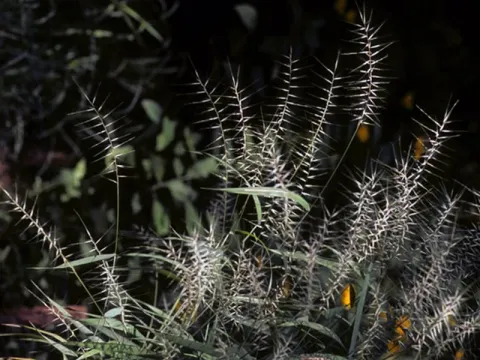
Knotroot foxtail
Setaria geniculata
Knotroot foxtail (Setaria geniculata) is a perennial grass belonging to the Poaceae family. While it often grows wild, in some agricultural regions, it is managed as a component of permanent pastures or forage stands in warm climates.
What the section contains
Knotroot foxtail
The sowing process is highly dependent on climate, as this grass is sensitive to cold soil. The ideal time for planting is late spring when soil temperatures consistently reach 15–18 degrees Celsius, ensuring rapid germination.
Seeds of knotroot foxtail should be planted at a shallow depth of 1–2 centimeters. This prevents excessive energy consumption by the seedling during emergence and maintains optimal soil moisture contact.
In managed grazing systems, row planting is commonly used to ensure uniform stand density. Because the plant spreads via rhizomes, it is capable of filling in gaps in the stand over time, making it highly persistent under grazing pressure.
Early-season weed control is essential for successful establishment. Once the seedlings have reached the stooling stage, the plant becomes quite aggressive and can effectively compete with most annual weeds.
As a warm-season grass, knotroot foxtail thrives in high-temperature environments. It exhibits its highest growth rate when temperatures range between 25 and 35 degrees Celsius, showing excellent heat tolerance.
The species is highly adaptable regarding soil types, performing well even on sandy, low-fertility, or poorly structured soils. It prefers neutral pH levels but can tolerate slightly acidic conditions common in degraded pastures.
Sunlight is a key requirement for the development of knotroot foxtail. It does not perform well in shaded conditions and should be planted in open areas to maximize biomass production for forage needs.
It is noted for its drought resistance, making it a valuable species for regions with seasonal water shortages. Its deep root system allows it to maintain vigor even when surface layers of soil are dry.
Fertilization with nitrogen can significantly boost forage yield, especially during the active growth phases. However, balanced soil fertility is key; phosphorus is particularly important for promoting root development and longevity.
Knotroot foxtail is primarily utilized as a forage crop. It provides high-quality grazing material during the early vegetative stage, being highly palatable and nutritious for cattle and other livestock.
The biomass yield is heavily influenced by the grazing management strategy. Continuous overgrazing can deplete rhizome reserves, while well-managed rotational grazing cycles allow for rapid recovery and multiple harvests per season.
Although it is not classified as an intensive yield crop like some alfalfa or hybrid grasses, its reliability in difficult environments makes it an asset for livestock producers in tropical and subtropical zones.
Farmers must be mindful of the plant’s maturity. Once the plant enters the reproductive stage and produces seed heads, the nutritional value drops significantly due to increased lignification, which reduces digestibility for livestock.
Integrated use, such as grazing during the peak vegetative season followed by a resting period, is the most efficient way to maintain a consistent supply of forage while ensuring the plant stands remain productive for years.
Setaria geniculata is generally robust and less prone to catastrophic disease outbreaks compared to monoculture grain crops. However, rust diseases can appear during periods of high humidity and poor air circulation.
Fusarium root rot can become an issue in fields with significant waterlogging or soil compaction. These conditions weaken the plant's natural defense systems, leading to reduced vigor and thinning of the stand.
Common pests include grass-feeding aphids and various species of stem flies. These pests feed on the succulent parts of the plant during the growing season, potentially causing stunted growth and leaf deformation.
Integrated Pest Management (IPM) for this grass focuses on cultural practices rather than chemical intervention. Maintaining proper stand density and timely mowing often disrupts pest life cycles effectively.
To prevent disease accumulation, avoid over-fertilizing with nitrogen alone, as this promotes succulent, pest-attractive tissue. Balanced nutrient management is the best defense against major plant health issues.
Harvesting knotroot foxtail for hay should occur before the plants reach the inflorescence stage. Cutting at this time ensures the best balance of protein content and fiber digestibility for livestock feed.
When cutting for hay, a stubble height of 5–8 centimeters should be left to allow for rapid regrowth from the rhizomes. This practice is vital for maintaining the health of the stand over subsequent years.
The stems of knotroot foxtail can be thick and retain moisture, making the drying process longer than that of thinner grasses. Utilizing a mower-conditioner to crush the stems significantly speeds up the drying process.
Preventing the production of viable seeds is important if the area is adjacent to other agricultural crops. The plant’s potential for rapid spreading can make it a nuisance in nearby tillage fields if left to mature fully.
Post-harvest, the regrowth (aftermath) provides excellent late-season grazing. If moisture levels are adequate, the stand will recover quickly, allowing for extended utilization before the onset of dormancy.