
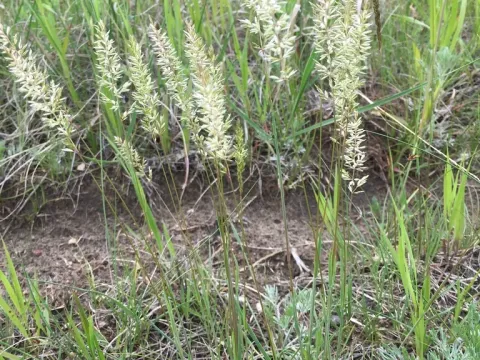
Koeleria
Koeleria Pers.
Koeleria, a member of the Poaceae family, is a perennial grass typically established via direct seeding in early spring or autumn. For successful germination, the soil must be well-prepared, fine-textured, and adequately moist to support the growth of its small, lightweight seeds.
What the section contains


Koeleria
The sowing depth is critical, as seeds should be placed no deeper than 1–2 cm. Broadcasting or drilling are common methods, followed by firm rolling to ensure optimal seed-to-soil contact, which significantly improves the establishment rate of the seedlings.
Seeding rates typically range from 8 to 12 kg per hectare when planted as a monoculture. In forage mixtures, the rate is adjusted to ensure that Koeleria constitutes a stable portion of the stand without outcompeting other species during the early growth phases.
Seedlings develop slowly, focusing initially on root architecture. Consequently, field maintenance during the first season should prioritize weed control, as young plants are highly susceptible to competition from fast-growing weeds.
Autumn seeding is often preferred in regions with mild winters to allow for natural stratification, which can improve germination uniformity in the following spring. Regardless of the season, a frost-free window is necessary for the initial establishment phase.
Koeleria is recognized for its exceptional drought tolerance and resilience, making it a suitable choice for semi-arid and temperate regions. It thrives in open, sunny environments and is highly sensitive to shading from canopy cover or aggressive weeds.
The ideal soil conditions for this grass include well-drained, sandy, or loamy substrates. It is particularly well-adapted to neutral or slightly alkaline soils and performs remarkably well on rocky or impoverished terrain where other, more demanding species might fail.
This species exhibits strong frost resistance and can endure harsh winter conditions without the need for extensive insulation. It remains a reliable component of native grassland ecosystems due to its ability to survive temperature extremes.
While the plant can grow on nutrient-poor sites, its biomass production is significantly enhanced by judicious phosphorus and potassium fertilization. Nitrogen applications can also stimulate vegetative growth in early spring, promoting rapid green-up.
Water requirements are generally low, as the plant possesses a deep and efficient root system. It is well-suited for restoring degraded pastures and stabilizing soil in areas subject to wind erosion or intense solar exposure.
While Koeleria may not match the total biomass yield of high-input grasses like ryegrass, its biological reliability under stress is its greatest asset. It provides consistent, high-quality forage during periods when more sensitive crops show reduced productivity.
Typical hay yields are moderate, usually ranging from 1.5 to 2.5 tonnes per hectare, depending on local fertility and precipitation levels. Its value is best realized in pastoral systems, where its persistence and nutritive profile are highly utilized.
The forage quality of Koeleria is excellent, offering high protein content and digestibility. It remains palatable throughout the growing season, which makes it an ideal feed source for sheep, cattle, and equine grazing operations.
The grass is highly adapted to grazing and demonstrates strong recovery after biomass removal. Due to its basal growth habit, it can withstand intensive grazing pressure without losing ground cover, contributing to long-term pasture sustainability.
For hay production, harvest should be timed during the boot to early heading stage to maximize the nutrient balance. Cutting too late results in lignification of the stems, which decreases overall digestibility and quality for livestock feed.
Koeleria is generally resistant to many common grass diseases, contributing to its status as a low-maintenance forage option. However, in environments with poor air circulation and high humidity, infections like powdery mildew can periodically occur.
Insects such as grass bugs and cereal aphids are the primary pests. Monitoring the population density of these insects is essential, especially in seed-production fields where damage to developing florets could drastically reduce the harvest.
Root rot pathogens may arise if the crop is grown continuously on the same site for many years without rotation. Integrating Koeleria into a diverse crop rotation cycle is recommended to mitigate the build-up of soil-borne pathogens.
Weed management remains the most critical task during the establishment phase. Using appropriate mechanical cultivation or selective herbicide applications during the initial spring growth helps to ensure a uniform and productive stand.
In mature pastures, overgrazing can lead to the invasion of less desirable weed species. Maintaining a proper stocking rate and allowing for periodic rest periods during the growing season is vital to keep the Koeleria population vigorous and dominant.