
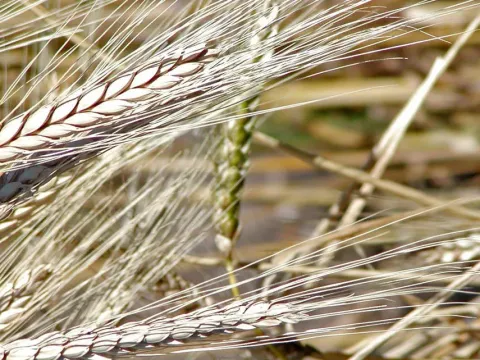
Khorasan wheat
Triticum turanicum
Khorasan wheat, botanically classified as Triticum turanicum, is typically grown as a spring crop, requiring early sowing once the soil temperature consistently reaches 5 to 8 degrees Celsius.
What the section contains
Khorasan wheat
Seed depth should be managed carefully, usually between 4 and 6 centimeters, to ensure the seedling establishes a robust root system capable of supporting heavy grain heads.
The sowing rate must be adjusted based on seed size, as this ancient grain often requires lower seeding densities due to its ability to tiller vigorously during the early growth stages.
Precision calibration of planting equipment is essential because the unique, elongated shape of the grain can cause issues with standard drill settings if not checked beforehand.
Rolling the soil after planting is recommended in dry climates to ensure optimal soil-to-seed contact, promoting uniform germination across the entire field.
As a member of the Poaceae family, Khorasan wheat is renowned for its remarkable drought tolerance and adaptability to harsh, arid environmental conditions where other wheat varieties might fail.
The crop thrives in well-drained, fertile soil types, such as loams or chernozems, but it is highly sensitive to waterlogged conditions, which can lead to root rot and reduced yields.
Triticum turanicum possesses a deep and efficient root system that allows it to access subsoil moisture, making it a suitable choice for sustainable farming in semi-arid regions.
Abundant sunlight is critical for the development of this grain, as shade can significantly hinder stalk strength and lead to issues with lodging before the harvest period.
The plant performs best under moderate temperatures of 20–25 degrees Celsius and exhibits impressive resilience to extreme diurnal temperature shifts common in continental climates.
The primary threats to Khorasan wheat crops are fungal pathogens, specifically rusts and powdery mildew, which tend to proliferate during seasons with unusually high humidity levels.
Insects like the wheat bug and grain aphids can cause significant damage to the plant's vascular system and grain development, requiring consistent field scouting throughout the spring.
Effective management includes seed treatment to prevent smut diseases and the implementation of diverse crop rotation strategies to break the lifecycle of soil-borne pests.
The tall and sturdy stature of this wheat variety provides a competitive advantage against weeds, often reducing the need for intensive herbicide applications in organic systems.
- Proactive fungicide application at the first sign of leaf disease
- Integrated pest management practices to control insect outbreaks
- Use of certified pathogen-free seeds to ensure initial field health
Harvesting should take place when the crop reaches full maturity and the grain moisture content is within the ideal 12–14 percent range to ensure long-term stability in storage.
Operators must carefully adjust combine harvester settings, particularly the drum speed, to prevent breakage of the large, elongated grains which are more brittle than modern wheat.
The high nutritional quality of Triticum turanicum makes it a premium product, necessitating careful handling from the field to the grain elevator to avoid contamination with other varieties.
Post-harvest processing involves gentle cleaning and drying to maintain the integrity of the grain's bran and germ, which are central to its health-promoting properties.
Storage facilities must be well-ventilated and kept at appropriate humidity levels to protect the grain from pests and mold, preserving its value for the specialty food market.