
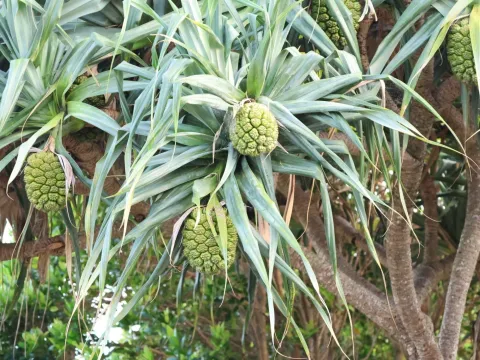
Pandanus
Pandanus
Pandanus (Pandanus) is a genus of tropical plants belonging to the Pandanaceae family. These plants are native to the tropical regions of Asia, Africa, and the Pacific islands, typically inhabiting coastal areas, riverbanks, and marshy environments.
What the section contains
 Bonin screw pine
Pandanus boninensis
Bonin screw pine
Pandanus boninensis
 Forest screw pine
Pandanus sylvestris
Grass-leaved screw pine
Pandanus graminifolius
Luzon screw pine
Pandanus luzonensis
Forest screw pine
Pandanus sylvestris
Grass-leaved screw pine
Pandanus graminifolius
Luzon screw pine
Pandanus luzonensis
 Mountain pandanus
Pandanus montanus
Pandanus ceylanicus
Pandanus ceylanicus
Mountain pandanus
Pandanus montanus
Pandanus ceylanicus
Pandanus ceylanicus
 Pandanus chiliocarpus
Pandanus chiliocarpus
Pandanus chiliocarpus
 Pandanus cookii
Pandanus cookii
Pandanus cookii
 Pandanus dubius
Pandanus houlletii
Pandanus houlletii
Pandanus dubius
Pandanus dubius
Pandanus houlletii
Pandanus houlletii
 Pandanus julianettii
Pandanus julianettii
Pandanus julianettii
 Pandanus kaida
Pandanus kaida
Pandanus kaida
 Pandanus labyrinthicus
Pandanus lais
Pandanus lais
Pandanus labyrinthicus
Pandanus labyrinthicus
Pandanus lais
Pandanus lais
 Pandanus multispicatus
Pandanus multispicatus
Pandanus multispicatus
 Pandanus odorifer
Pandanus odorifer
Pandanus odorifer
 Pandanus ornatus
Pandanus ornatus
Pandanus ornatus
 Pandanus spiralis
Pandanus spiralis
Pandanus spiralis
 Pandanus tectorius
Pandanus tectorius
Pandanus tectorius
 Pandanus utilis
Pandanus utilis
Pandanus utilis
 Pandanus veitchii
Pandanus veitchii
Pandanus veitchii
 Penang pandanus
Pandanus penangensis
Penang pandanus
Pandanus penangensis
 Purple Pandanus
Pandanus purpurascens
Purple Pandanus
Pandanus purpurascens
 Pygmy screw pine
Pandanus pygmaeus
Pygmy screw pine
Pandanus pygmaeus
Pandanus
Successful cultivation requires high temperatures, ideally ranging between 20 and 30 degrees Celsius. The crop is highly sensitive to cold stress and frost, which can cause irreversible damage to the vascular system and leaf tissue.
Soil requirements for Pandanus involve well-draining, nutrient-rich substrates with a slightly acidic to neutral pH. In agricultural settings, maintaining moderate soil moisture is crucial, as the plant cannot tolerate waterlogged conditions that lead to root rot.
Botanically, Pandanus is characterized by its distinctive stilt roots or prop roots, which provide structural stability in sandy or unstable coastal soils. The leaves are typically long, narrow, and arranged in a spiral pattern, often featuring serrated, thorny margins.
Economic uses of Pandanus are diverse. The leaves are highly valued for their strong fibers, which are utilized in the manufacturing of mats, baskets, textiles, and cordage. In many regions, the fruit is a source of starch and nutrition for local populations.
Major pests affecting Pandanus include mealybugs, scale insects, and spider mites, which thrive in low-humidity environments. Integrated pest management using biological controls or mild systemic insecticides is generally recommended.
Fungal pathogens causing leaf spot or root decay are the primary disease threats. These are typically managed by ensuring adequate air circulation around the plants and avoiding overhead irrigation that leaves water on the foliage for extended periods.