
Pandan
Pandanus Parkinson
Pandan (Pandanus) is a genus of monocotyledonous woody plants belonging to the family Pandanaceae, comprising hundreds of species, with the most notable being the fragrant screw pine. This tropical crop naturally thrives in coastal regions, on islands across the Pacific and Indian Oceans, and throughout Southeast Asia.
What the section contains

Pandan
Successful cultivation of Pandan requires a humid tropical climate with temperatures consistently between +20°C and +30°C. The plant is extremely sensitive to cold and cannot withstand even brief periods of frost, which restricts its commercial production to tropical regions.
The crop prefers well-drained, fertile loamy or sandy soils. High levels of atmospheric and soil humidity are critical requirements, although Pandan does not tolerate waterlogging in the root zone, which can easily trigger rot and decay.
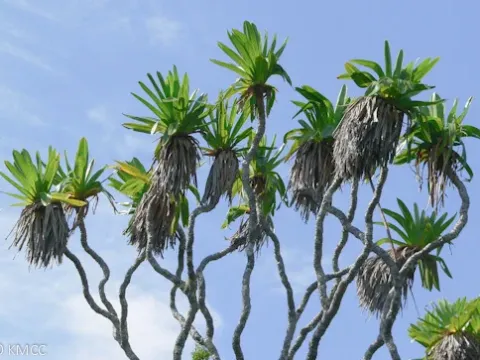
The plant exhibits unique morphology, characterized by stilt roots that support the heavy trunk and long, leathery, sword-shaped leaves arranged in a spiral pattern. Many species feature spines along the leaf edges, which must be carefully managed during maintenance and harvesting.
Economically, Pandan is highly valued for its fragrant leaves, widely used in Asian cuisine as a natural flavor enhancer and coloring agent for desserts and rice. Additionally, the fibrous leaves are harvested as a raw material for weaving mats, baskets, and producing specialty paper.
The main pests affecting Pandan include mealybugs and spider mites, which thrive in conditions of high humidity and poor air circulation. Regular inspection of the foliage and the application of appropriate insecticides help mitigate potential damage from these pests.
Fungal diseases, such as leaf spot, are common in poorly ventilated plantations or when irrigation regimes are incorrectly managed. Ensuring adequate airflow between plants is essential for the effective prevention of these diseases.
Root rot represents a severe threat to young seedlings when soil moisture levels are excessive. Agronomists recommend strictly adhering to irrigation schedules and utilizing fungicides at the first sign of collar rot or root deterioration.
Viral infections can spread through contaminated pruning tools, necessitating the regular disinfection of all agricultural equipment. Using sterile tools is a fundamental practice to maintain the overall health of the plantation.
Nematodes may attack the root system of Pandan in light-textured soils. Implementing biological control methods and proper crop rotation strategies can significantly reduce the risk of soil-borne nematode infestations.
Harvesting Pandan leaves is conducted selectively, beginning with the lower parts of the plant as they mature. Great care must be taken to avoid damaging the terminal bud to ensure continued growth and consistent future yields.
For high-quality commercial yield, only mature, fully developed dark green leaves are harvested. The optimal timing for the harvest is dictated by the aromatic intensity of the leaves, which peaks in fully mature plants.
Harvested crops require immediate processing or transport to a cool environment to preserve their essential oils. The leaves lose their culinary properties rapidly if subjected to improper storage temperatures after picking.
For fiber production, the leaves are dried naturally in the shade to maintain the elasticity and strength of the fibers. Over-drying can make the material brittle and unsuitable for high-quality handicraft or textile applications.
The overall yield of the crop depends heavily on soil fertility management and planting density. Strategic pruning practices help stimulate the growth of new shoots, ensuring a reliable and sustainable production of biomass over several years.