
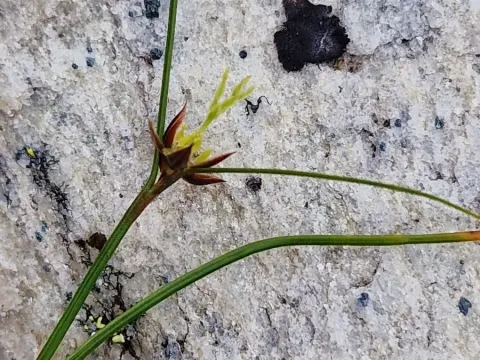
Highland rush
Juncus trifidus
Highland rush (Juncus trifidus) is a perennial herbaceous plant belonging to the Juncaceae family. It is a highly specialized species perfectly adapted to life in harsh alpine and subarctic environments.
What the section contains
Highland rush
The plant is native to the northern hemisphere's mountain ranges and arctic regions. It typically grows in dense tufts, which is an evolutionary strategy to survive high-velocity winds and the freezing temperatures of high-altitude zones.
Botanically, it is characterized by rigid, wire-like stems and reduced foliage. The plant's most distinct feature is the presence of three involucral bracts that surround the inflorescence, reflecting its species name "trifidus".
The growth requirements include well-drained but acidic and moist soils. It often colonizes rocky outcrops and scree slopes, acting as a pioneer species that stabilizes moving soils and prevents erosion in mountainous terrain.
While the economic utility of Highland rush as livestock feed is limited due to its low nutritional profile, its ecological role as a stabilizer of mountain meadows and alpine ecosystems is invaluable to local biodiversity.
Highland rush is exceptionally resilient to most common plant diseases. The extreme environmental conditions, such as short growing seasons and low temperatures, naturally suppress the proliferation of typical crop-related pathogens.
The primary threat to the species is overgrazing and trampling by livestock. When the protective turf is physically damaged, the root systems are exposed, leading to rapid degradation of the topsoil and loss of the plant habitat.
Specific pests for this species are limited in high-altitude zones. Occasionally, insects adapted to the alpine climate may feed on vegetative parts, but such occurrences are sporadic and generally do not impact population density.
Climate change poses a significant threat, as the species is sensitive to warming trends. As temperatures rise, competition from lowland and subalpine species increases, potentially forcing the Highland rush out of its ecological niche.
Conservation strategies should prioritize the protection of alpine habitats from industrial or agricultural exploitation. Maintaining the integrity of the soil layer is the most important factor in sustaining healthy populations of Juncus trifidus.