
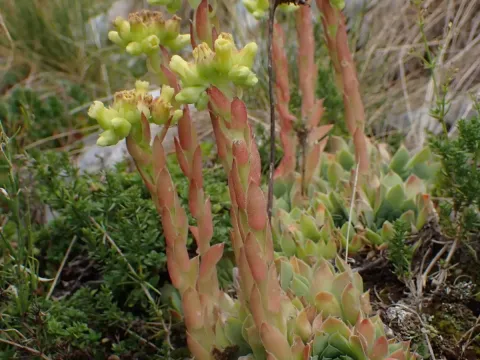
Jovibarba heuffelii
Jovibarba heuffelii
Jovibarba heuffelii is a perennial succulent belonging to the Crassulaceae family. It is native to the mountainous regions of Southeastern Europe, where it thrives in rocky crevices and poor soils of alpine slopes.
What the section contains
Jovibarba heuffelii
The plant is defined by its dense, evergreen rosettes of fleshy leaves. Unlike the common Sempervivum, its flowers feature uniquely shaped, yellowish petals that open fully. It is a slow-growing species well-adapted to high-altitude environments with limited resource availability.
Successful cultivation requires soil with excellent drainage, such as sandy or gravelly loam. The presence of organic matter should be limited to prevent water retention, which is the primary cause of root failure in this culture.
Jovibarba heuffelii demands full sun exposure to maintain its characteristic compact shape and vibrant leaf coloration. In shaded environments, the plant tends to lose its structural integrity and becomes susceptible to physiological stress.
This crop is highly winter-hardy and requires minimal water once established. Its use is focused on landscape architecture, specifically in xeriscaping, rock gardens, and stone wall plantings where maintenance must be kept to a bare minimum.
The most significant threat to Jovibarba heuffelii is root rot, triggered by poor drainage and excessive ambient humidity. Soil compaction and standing water significantly increase the risk of rapid tissue decay.
Aphids and mealybugs are the primary pests that infest the rosettes, feeding on sap. Early detection is essential, as these pests can weaken the plant, making it more prone to fungal colonization.
Slugs and snails can cause mechanical damage to the foliage during rainy periods, leaving unsightly scars that can lead to secondary infections. Utilizing coarse gravel around the rosettes acts as a deterrent for these pests.
Fungal diseases, such as leaf spot, may occur if air circulation is insufficient. Ensuring proper spacing and keeping the foliage dry are critical agronomical practices to mitigate these pathogen risks.
Regular sanitation, which includes removing dead leaves and weeds surrounding the plant base, is necessary to prevent pathogen buildup. Proper management of the microclimate around the plant is the most effective form of preventative control.