
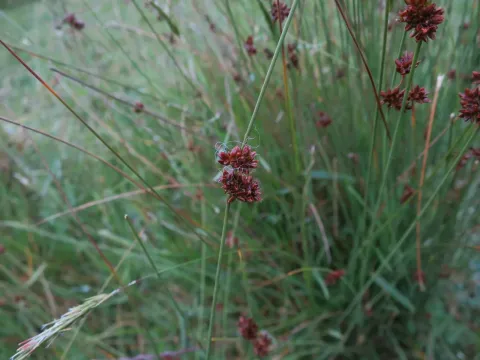
Jointed rush
Juncus filicaulis
Jointed rush (Juncus filiformis) is a perennial herb belonging to the Juncaceae family. In agricultural and landscaping contexts, it is highly valued for its ability to stabilize wet soils and its aesthetic appeal in riparian plantings.
What the section contains
Jointed rush
Propagation is most effectively achieved through division of the rhizomes in early spring. While the plant produces seeds, their germination rate under natural field conditions is variable and highly dependent on consistent moisture.
When establishing a colony, rhizome sections should be planted into saturated soil at a depth of about 5–10 centimeters to ensure firm anchoring against flowing water or wave action.
Density depends on the desired end result: for erosion control, closer spacing (15–20 cm) is recommended to form an interlocking root mat as quickly as possible.
The establishment phase requires careful monitoring. Young plants are sensitive to drying out, so the site must remain wet until the plants have successfully colonized the area.
The primary requirement for Juncus filiformis is high moisture. It is a hydrophytic species that thrives in wetlands, pond margins, and areas with high water tables, often standing in shallow water.
The plant prefers acidic, nutrient-poor, or organic-rich soils. It is particularly well-adapted to peaty or heavy clay soils that are prone to waterlogging, where many other plants fail.
It is a cold-hardy species, capable of surviving harsh winters and frost. Its wide distribution in northern temperate regions highlights its adaptability to cool climates and fluctuating seasonal temperatures.
While jointed rush tolerates partial shade, it achieves the most robust growth in sunny locations where it can fully develop its characteristic slender, thread-like stems.
Successful cultivation relies on maintaining high water levels. Periodic drying of the substrate is the main limiting factor, often leading to a rapid decline in plant health and stem vigor.
The agricultural output of jointed rush is generally not measured in traditional crop yield terms. Its value lies primarily in ecological services and soil conservation rather than forage production.
The plant serves as an excellent bio-filter in constructed wetlands. It efficiently absorbs excess nitrates and phosphates from runoff, making it a critical tool for water quality management.
In craft and artisanal sectors, the stems can be harvested for weaving, baskets, or decorative purposes. The stems possess sufficient durability for these specialized applications.
Its role in riparian management is its most significant economic contribution. By anchoring banks, it prevents costly soil erosion and reduces the need for expensive structural retaining walls.
While not a traditional food or fodder crop, its potential for biomass production in bio-remediation projects is increasingly recognized in sustainable environmental engineering.
Juncus filiformis is remarkably hardy and resistant to most common agricultural pests. Its wetland habitat protects it from many terrestrial insects that plague standard crops.
Fungal issues, such as leaf spot or stem rot, may occur if the plants are overcrowded or if air circulation is severely restricted, especially in stagnant, humid environments.
Managing the site through occasional thinning can improve airflow and reduce the likelihood of disease development, ensuring the long-term health of the planting.
Invasive species or aggressive weeds can occasionally compete with the rush during its establishment phase; manual removal of weeds is generally the safest management method.
Chemical control is rarely necessary and often discouraged given the rush's proximity to aquatic ecosystems, where runoff could damage sensitive water quality.
Harvesting for artisanal use is typically conducted manually at the end of the growing season when the stems are mature, fully elongated, and possess high structural strength.
After cutting, the stems should be bundled and air-dried in a sheltered, well-ventilated area to maintain their natural color and prevent the fibers from becoming brittle.
To ensure sustainable yields, harvesting should be performed on a rotational basis, allowing specific sections of the colony to recover and propagate naturally each year.
Care must be taken to harvest stems without damaging the underlying root system, as the rhizomes are the lifeblood of the plant and essential for regeneration.
Stored material must be kept in a dry environment to avoid moisture-related mold growth, which would compromise the quality and appearance of the stems for craft applications.