
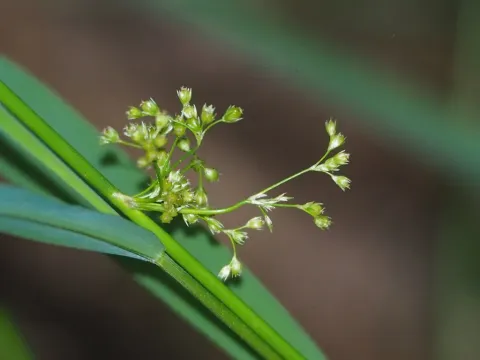
Juncus decipiens
Juncus decipiens
Sowing of Juncus decipiens seeds is primarily carried out in the spring when the soil warms up to a temperature of 12–15 degrees Celsius. To obtain uniform germination, seeds require preliminary stratification or soaking in growth stimulants, as they have a hard shell.
What the section contains
Juncus decipiens
The optimal planting depth for the seeds is no more than 0.5–1 centimeter, as the seeds are very small and sensitive to depth. It is recommended to slightly compact the soil surface after sowing to improve capillary contact between the seeds and the moist soil.
For industrial-scale cultivation, a transplanting method is often used, which allows for a more developed root system by the time of field planting. Seedlings are planted in the ground at the 3–4 true leaf stage, following a planting pattern that ensures sufficient nutrition area.
The seeding density directly depends on the purpose of cultivation — for biomass production, planting density is increased, whereas for ornamental or selective use, sparser patterns are applied.
An important success factor is weed control during the initial stages of growth, as Juncus decipiens develops slowly in the first weeks after germination and is heavily suppressed by weed vegetation.
Juncus decipiens belongs to the Juncaceae family and is a typical hydrophyte, which places high demands on environmental moisture. The plant develops best in waterlogged soils, along river floodplains, or in artificially irrigated areas.
The crop is relatively undemanding regarding soil type, yet it shows the best growth indicators on organic-rich loams and peatlands with a neutral or slightly acidic reaction. It is essential to ensure a stable groundwater level throughout the entire growing season.
The plant has high adaptability to various temperature regimes characteristic of the temperate climate of East Asia, where it originates. It is capable of withstanding temporary flooding, making it promising for use on problematic, excessively wet lands.
The light regime plays a key role: the culture is light-loving; in strong shade, stem elongation and a decrease in total plant biomass are observed. Providing open solar lighting is critical for the accumulation of fiber in the stems.
In Juncus agronomy, a critical aspect is the maintenance of mineral nutrition, especially nitrogen compounds, which stimulate rapid growth of the plant's aerial part in the first half of summer.
Harvesting Juncus decipiens for industrial purposes is carried out at the phase of full vegetative maturity when the stems reach maximum strength. This usually occurs at the end of August or in September, depending on the region of cultivation.
Stems are cut using mechanized methods with sharp blades to prevent fiber splitting. The cutting height should be minimal, as the main volume of valuable raw material is concentrated in the lower part of the stem.
Immediately after mowing, the collected mass undergoes primary processing — sorting by length and thickness of the stems. This is necessary to ensure the standardization of raw materials used in weaving and the production of technical goods.
Drying of the raw material takes place under natural conditions under canopies with good ventilation, which preserves fiber elasticity and prevents the development of mold fungi. Direct sunlight on cut stems is not allowed, as this leads to fading.
Storage of dried Juncus is carried out in dry, well-ventilated warehouse premises with an air humidity of no more than 15 percent to maintain the commercial appearance and material strength.