
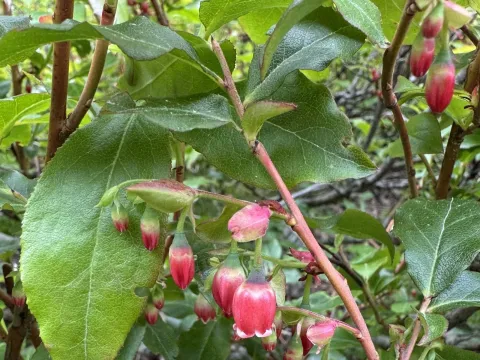
Caucasian whortleberry
Vaccinium arctostaphylos
Caucasian whortleberry (Vaccinium arctostaphylos) belongs to the Ericaceae family and is a deciduous shrub that can grow from one to three meters in height. In the wild, it propagates primarily through seeds dispersed by birds and vegetatively via rhizomes.
What the section contains
Caucasian whortleberry
For cultivation, seeds require stratification at low positive temperatures for 2–3 months. Sowing is best performed in early spring once the soil temperature reaches at least 10–12 degrees Celsius.
Cuttings are a more efficient method for preserving the specific traits of the plant. Hardwood cuttings are harvested in late winter and planted in a substrate high in peat to promote rooting.
Planting seedlings in open ground should occur either in the autumn before heavy frost or in early spring before the start of active sap flow. Sufficient moisture is essential for successful establishment.
Young plantations require careful weeding during the first two years, as the seedlings are highly sensitive to competition for nutrients and water from aggressive weeds.
The plant is a Tertiary relict, native to the forests of the Caucasus, Asia Minor, and Northern Iran. It prefers shaded or semi-shaded habitats with high air humidity.
Soil requirements include high acidity (pH 4.0–5.0) and high humus content. The root system is shallow, so a loose, well-aerated soil structure is crucial for healthy development.
Moderate but consistent irrigation is necessary. Water stagnation is detrimental to the roots, but drying out of the substrate leads to fruit drop and weakened plant immunity.
The climate should be moderate, avoiding extreme heat or strong winds. It thrives best in mountainous regions with a mild, humid climate.
Mycorrhizal fungi are essential companions for the Caucasian whortleberry. Without this symbiosis, the roots cannot efficiently absorb nitrogen and phosphorus, so introducing forest soil during planting is highly recommended.
The yield of the Caucasian whortleberry is generally lower than that of commercial highbush blueberry varieties, as it maintains its wild characteristics. Fruiting begins at 4–6 years of age.
The berries are gathered in small clusters; they have a dark blue color with a waxy bloom and a pleasant, tart taste. Each berry usually weighs between 0.3 and 0.7 grams.
Pruning is key to increasing yield. Removing old, five-to-six-year-old branches stimulates the growth of new shoots, which bear the majority of the fruit.
Berries are used commercially for jams, preserves, juices, and drying. They are particularly rich in anthocyanins and tannins, making them highly valued for health supplements.
Pollination success depends heavily on weather conditions during late spring flowering. Frost during this period can significantly reduce the potential harvest.
The main threats include fungal diseases like rust and powdery mildew, which thrive in conditions of poor ventilation and excessive moisture.
Gray mold can damage the fruit during prolonged rainy periods. Preventive measures include regular thinning of the canopy to improve air circulation and the use of copper-based fungicides.
Pests such as leafrollers and various caterpillars feed on young foliage and buds. Regular monitoring and biological control methods are advised to manage these insects.
White grub larvae can damage the root system of young plants. It is wise to inspect the site for soil pests before establishing new plantings.
Due to the sensitivity of the plant to chemical inputs, integrated pest management and organic alternatives are preferred over heavy synthetic pesticide use.
Harvesting usually takes place in August and September. Since the berries do not ripen simultaneously, multiple passes through the plantation are often necessary to collect ripe fruit.
Harvesting should be done in dry weather, as wet berries are prone to rapid spoilage during storage. Collected fruit must be cooled to 2–4 degrees Celsius immediately.
Care must be taken during manual picking to avoid damaging the fruiting buds located at the leaf axils, which are essential for the following year's crop.
Transportation should be carried out in well-ventilated containers. Avoid overfilling crates to prevent the berries from being crushed under their own weight.
Freezing or drying are the best methods for preserving the berries, as these techniques maintain the high levels of bioactive compounds found in this wild species.