
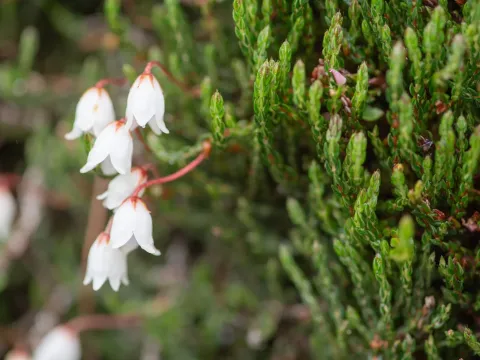
Cassiope selaginoides
Cassiope selaginoides
Cassiope selaginoides is a distinguished member of the Ericaceae family, known for its slow-growing, evergreen, and moss-like appearance. It is highly valued in specialty horticulture for rock gardens and alpine houses due to its unique architectural form.
What the section contains
Cassiope selaginoides
Native to the high-altitude regions of the Himalayas and Western China, the species thrives in cool, humid environments. Successful cultivation requires a site that offers protection from intense afternoon sun and ensures good air circulation to prevent overheating.
Soil requirements are strict: the medium must be highly acidic, peaty, and porous. Growers typically utilize a mixture of pulverized pine bark, coarse sand, and leaf mold to mimic the well-drained, nutrient-rich conditions of its mountainous habitat.
Watering must be precise, using soft, lime-free water to maintain the required soil pH. The roots are exceptionally sensitive to mineral build-up, so regular flushing with rainwater is recommended to keep the substrate fresh and free from salts.
In terms of botany, the plant features imbricate, scale-like leaves that create a dense, compact foliage mass. The bell-shaped, white flowers emerge from the axils of the upper leaves, blooming during the spring and early summer months.
Root rot caused by waterlogging is the primary threat to Cassiope selaginoides. Because the root system is fine and shallow, any stagnant water leads to rapid decay, which is often irreversible if not detected at the earliest stage.
Spider mites represent a significant risk, particularly when the ambient humidity drops too low during dry spells. These pests damage the delicate scale leaves, causing them to lose their vibrant green color and eventually drop off.
Fungal infections, such as Botrytis, can affect the plant during periods of high humidity and poor air movement. It is essential to prune away any necrotic tissue promptly to prevent the spread of spores throughout the specimen.
In containerized settings, root mealybugs can pose a hidden danger. Regular monitoring of the root ball is advised to ensure that the plant remains vigorous and free from systemic infestations that sap its energy.
Environmental stress, specifically improper pH levels in the growing medium, will manifest as chlorosis. This physiological disorder hinders photosynthesis and weakens the plant, making it more susceptible to opportunistic secondary pathogens.