
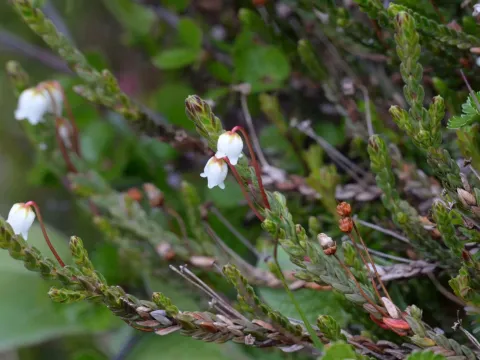
Cassiope tetragona
Cassiope tetragona
Cassiope tetragona, commonly known as the white arctic mountain heather, is an evergreen dwarf shrub belonging to the Ericaceae family. The plant is distinct for its scale-like leaves that are pressed tightly to the stem, resulting in a characteristic four-angled appearance.
What the section contains
Cassiope tetragona
The species is naturally distributed throughout the circumpolar Arctic regions and high alpine altitudes across the Northern Hemisphere. It serves as a classic indicator species for stable tundra environments and well-drained rocky slopes.
Regarding growth requirements, it demands highly acidic, nutrient-poor, yet well-drained soil. It thrives in locations where snow cover persists late into the spring, as this insulation protects the evergreen foliage from desiccation caused by harsh winter winds.
While not a commercial agricultural crop, the species is significant for habitat restoration in subarctic regions. Its extensive root systems help stabilize loose substrates in rocky alpine terrain, preventing soil erosion.
Horticultural applications remain limited to specialty rock gardens and alpine collections where specific soil acidification and drainage can be meticulously managed to mimic the plant's natural tundra habitat.
The primary threats to Cassiope tetragona include climate-induced shifts in moisture availability and physical habitat destruction. The plant exhibits slow recovery rates, making it highly sensitive to trampling and mechanical disturbance.
In terms of pathology, the species is susceptible to root rots and fungal infections when subjected to poor drainage. Excessive water accumulation in the root zone during summer months is particularly detrimental to its survival.
Pest pressure in its native habitat is relatively low; however, various arctic insect larvae may occasionally feed on young tissue. In controlled garden environments, typical garden pests are rarely an issue if the climate is cool enough.
Environmental degradation, including the melting of permafrost, poses a significant threat to the plant's ability to maintain its niche. Increased temperatures can lead to competition with more aggressive vascular plants.
Management strategies for cultivation focus on ensuring rigorous drainage and avoiding any soil amendments that would raise the pH level beyond the preferred acidic range, as this quickly leads to plant decline.