
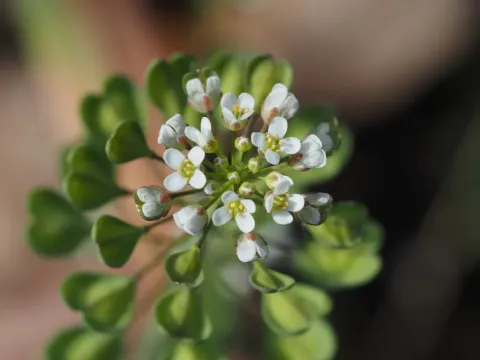
Pennycress
Noccaea
Pennycress (Noccaea) is a member of the Brassicaceae family, gaining attention as a winter annual oilseed cover crop. It occupies a unique niche in agricultural rotations, allowing farmers to produce biofuel feedstock in the off-season without disrupting summer crop cycles.
What the section contains
 Alpine pennycress
Noccaea caerulescens
Alpine pennycress
Noccaea caerulescens
 Daisy-leaved Noccaea
Noccaea bellidifolia
Daisy-leaved Noccaea
Noccaea bellidifolia
 Fendler's pennycress
Noccaea fendleri
Fendler's pennycress
Noccaea fendleri
 Kovats' pennycress
Noccaea kovatsii
Kovats' pennycress
Noccaea kovatsii
 Mountain pennycress
Noccaea montana
Noccaea andersonii
Noccaea andersonii
Noccaea brachycephala
Noccaea brachycephala
Mountain pennycress
Noccaea montana
Noccaea andersonii
Noccaea andersonii
Noccaea brachycephala
Noccaea brachycephala
 Noccaea brevistyla
Noccaea cochlearioides
Noccaea cochlearioides
Noccaea dacica
Noccaea dacica
Noccaea germanii
Noccaea germanii
Noccaea brevistyla
Noccaea brevistyla
Noccaea cochlearioides
Noccaea cochlearioides
Noccaea dacica
Noccaea dacica
Noccaea germanii
Noccaea germanii
 Noccaea goesingensis
Noccaea goesingensis
Noccaea goesingensis
 Noccaea macrantha
Noccaea microphylla
Noccaea microphylla
Noccaea macrantha
Noccaea macrantha
Noccaea microphylla
Noccaea microphylla
 Noccaea nevadensis
Noccaea ochroleuca
Noccaea ochroleuca
Noccaea nevadensis
Noccaea nevadensis
Noccaea ochroleuca
Noccaea ochroleuca
 Noccaea platycarpa
Noccaea praecox
Noccaea praecox
Noccaea platycarpa
Noccaea platycarpa
Noccaea praecox
Noccaea praecox
 Noccaea stilosa
Noccaea stilosa
Noccaea stilosa
 Noccaea sylvia
Noccaea vesicaria
Noccaea vesicaria
Noccaea sylvia
Noccaea sylvia
Noccaea vesicaria
Noccaea vesicaria
 Onion-leaved Noccaea
Noccaea cepaeifolia
Onion-leaved Noccaea
Noccaea cepaeifolia
 Round-leaved pennycress
Noccaea rotundifolia
Round-leaved pennycress
Noccaea rotundifolia
Pennycress
Sowing typically occurs in late summer or early autumn for winter varieties. This timing is essential for the plants to establish a robust basal rosette before the first hard frost, which ensures winter survival and promotes vigorous spring growth as soon as temperatures rise.
For spring varieties, planting should happen as early as the soil can be worked. Rapid establishment is key for the crop to compete effectively with early-season weeds and to utilize deep soil moisture before the onset of summer drought conditions.
The optimal planting depth is shallow, usually around 1 to 2 centimeters. Because the seeds are small, excessive depth can significantly reduce germination energy and lead to poor field emergence, requiring careful calibration of the seed drill.
The seeding rate is targeted to achieve high plant density, often between 250 and 400 plants per square meter. This density is crucial for maximizing light interception and creating a canopy that suppresses weeds, minimizing the need for subsequent herbicide applications.
Pennycress is exceptionally cold-hardy, capable of surviving harsh winter conditions. It prefers full sun and well-drained, fertile soil. While it can adapt to various soil types, performance is maximized on loam or silty loam soils that do not suffer from waterlogging.
Soil pH should ideally be neutral or slightly alkaline. In acidic conditions, growth may be stunted, and nutrient uptake efficiency is reduced, potentially impacting the final oil yield. Proper liming is recommended for soils that do not meet these criteria.
Moisture availability is most critical during the flowering and seed-filling stages. While pennycress is drought-tolerant during its vegetative phase, a severe lack of water during grain filling can result in shriveled seeds and a lower oil content, affecting the economic bottom line.
Nutrient management focuses on nitrogen, which is applied in early spring to stimulate the rapid bolting phase. Phosphorus and potassium levels should be monitored to ensure strong root development and winter resilience, which are fundamental for successful overwintering.
Integrated weed management is vital during the early establishment phase. While a dense stand provides good natural suppression, early control of aggressive winter annual weeds is necessary to prevent competition for nutrients and space during the autumn growth period.
The yield potential of pennycress is promising, with modern breeding efforts aiming for consistent yields of 1.5 to 2.5 metric tons per hectare. Its high oil content, typically between 30 and 35 percent, makes it highly suitable for renewable diesel and jet fuel production.
Oil quality is a major factor in its industrial utility. The chemical profile of the oil makes it an excellent feedstock for low-carbon fuels. Ongoing genetic selection focuses on increasing seed size and improving harvesting characteristics, such as uniformity of ripening.
Productivity is directly linked to the branching habit of the plant. A well-managed crop produces numerous pods on the main stem and side branches, which allows for compensatory growth even if the initial stand is slightly thinner than expected.
Harvesting efficiency is a critical determinant of actual yield. As seeds can shatter if left in the field for too long, timing the harvest correctly when moisture content is optimal is essential to capture the full economic value of the standing crop.
Farmers can expect high economic efficiency from pennycress because it adds value to land that would otherwise remain fallow during winter, providing a dual-benefit of soil protection and extra income generation without significant capital investment in new machinery.
Like other Brassicaceae, pennycress faces risks from specific pests and diseases. Downy mildew and white rust are common fungal issues, particularly in high-humidity environments, which can damage foliage and interfere with photosynthetic activity.
Alternaria leaf spot can lead to premature senescence and pod damage, reducing yield quality. Implementing a diversified crop rotation is the most effective cultural practice to break the disease cycle and reduce inoculum levels in the soil.
Crucifer flea beetles are the primary insect threat, posing a danger to young seedlings shortly after emergence. Seed treatments with appropriate insecticides are highly recommended as a standard prophylactic measure to protect the crop during its most vulnerable phase.
The rape blossom beetle is another threat that can damage floral buds, preventing pollination and pod set. Monitoring field populations during the bolting stage is necessary to determine if insecticidal intervention is required to protect the potential seed yield.
Management of these threats requires a systematic approach, including monitoring and scouting. By utilizing integrated pest management strategies, farmers can effectively maintain crop health while minimizing the environmental footprint of their chemical applications.
Harvesting pennycress is a precise operation that should be carried out when seed moisture reaches approximately 12 percent. By this time, the pods should be brown and dry, indicating that the seeds have reached physiological maturity.
Direct combining is the standard method for harvest, using specialized headers or by adjusting standard grain combine settings. Slowing down the drum speed and optimizing airflow is critical to prevent the small, oil-rich seeds from being cracked or lost through the straw walkers.
In cases of uneven ripening, swathing can be a useful alternative. Cutting the crop into windrows allows it to dry down naturally and uniformly, which reduces the moisture content and makes the subsequent combining process faster and more efficient.
Post-harvest handling requires quick cleaning to remove green plant debris, which can cause heating and degradation of the oil if left in storage. Effective aeration of the storage bins is essential to preserve the stability and purity of the oil content.
Proper harvest logistics ensure that the harvested crop retains its high quality for industrial processing. By investing time in combine calibration and moisture management, producers can maximize their returns from this unique and productive winter oilseed crop.