
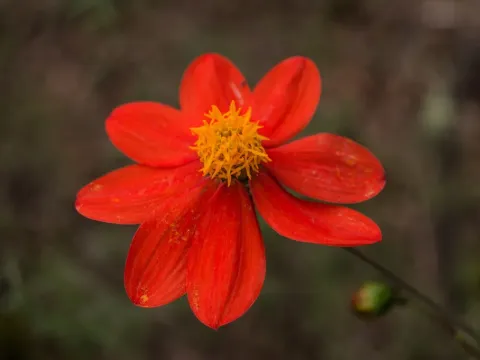
Dahlia
Dahlia Cav.
Dahlia propagation is typically carried out by dividing tuberous roots in the spring or by sowing seeds under controlled greenhouse conditions. Division is the preferred method for maintaining the unique characteristics of specific commercial cultivars.
What the section contains
 Bell dahlia
Dahlia campanulata Saar et al.
Dahlia
Dahlia brevis P. D. Sørensenx D. pinnata Cav.
Bell dahlia
Dahlia campanulata Saar et al.
Dahlia
Dahlia brevis P. D. Sørensenx D. pinnata Cav.
 Dahlia
 x hortensis Guillaumin
Dahlia
Dahlia x cultorum Thorsr. et Reis.
Dahlia
Dahlia x hortensis Guillaumin
Dahlia
Dahlia x cultorum Thorsr. et Reis.
 Dahlia brevis
 P. D. Sørensen
Dahlia dissecta
Dahlia dissecta x Dahlia rupicola
Dahlia brevis
Dahlia brevis P. D. Sørensen
Dahlia dissecta
Dahlia dissecta x Dahlia rupicola
 Dahlia merckii
 Lehm. x D. dissecta S. Watson
Dahlia merckii
Dahlia merckii Lehm. x D. dissecta S. Watson
 Dahlia merckii
 Lehm.
Dahlia merckii
Dahlia merckii Lehm.
 Dahlia pinnata
 Cav.
Dahlia pinnata
Dahlia pinnata Cav.
 Dissected dahlia
Dahlia dissecta S. Watson
Dissected dahlia
Dahlia dissecta S. Watson
 Rock Dahlia
Dahlia rupicola P. D. Sorensen
Rock Dahlia
Dahlia rupicola P. D. Sorensen
 Scarlet dahlia
Dahlia coccinea Cav.
Scarlet dahlia
Dahlia coccinea Cav.
Dahlia
For tuber division, the root clumps are brought into a warm, bright environment several weeks before planting to encourage the sprouting of eyes. Each division must contain at least one healthy eye to ensure successful growth after transplantation.
Seed-grown dahlias are usually started in late winter or early spring in seed trays. This approach is highly effective for breeding new varieties and produces vigorous plants that reach maturity by mid-summer.
Transplanting into open ground occurs only after the danger of frost has passed, as these plants from the Asteraceae family are highly sensitive to low temperatures. Soil preparation should include the incorporation of organic matter to improve aeration.
Originating from the mountainous regions of Mexico and Central America, dahlias have evolved to survive in diverse conditions, yet they remain strictly perennial species requiring winter protection in colder temperate zones.
Successful dahlia farming requires full sun exposure for at least six to eight hours per day to maximize flower production and stem strength. Insufficient light levels lead to etiolation and poor bud formation.
The ideal soil is well-drained, fertile, and slightly acidic or neutral. Because dahlias are susceptible to root rot, maintaining an optimal soil structure that prevents waterlogging is essential for commercial success.
Water management is critical; plants require consistent moisture during the growing phase but are prone to decay if soil remains saturated. Drip irrigation systems are often employed to maintain uniform humidity levels in the root zone.
Fertilization schedules should prioritize balanced nutrients, with a shift towards higher potassium levels as the flowering period approaches. Nitrogen excess must be avoided to prevent soft, succulent growth that is prone to pests.
Temperature regulation is paramount, with a range of 18–25 degrees Celsius being optimal. Using mulch helps regulate soil temperature and conserve moisture, especially in regions with high diurnal temperature variations.
Dahlias are prone to various fungal pathologies, including Verticillium wilt, Rhizoctonia, and Sclerotinia, which often thrive in damp conditions. Proper site sanitation and crop rotation are the primary defenses against these soil-borne threats.
Southern blight (Sclerotium rolfsii) and Fusarium wilt represent significant challenges for intensive cultivation. If infection occurs, it is essential to remove the entire plant and surrounding soil to prevent the spread of sclerotia in the garden bed.
Viral infections, including the tomato mosaic virus, cause significant stunting and chlorosis. Because there is no chemical cure for these viruses, insect control (especially of aphids and thrips) is the only viable management strategy.
Leaf spots, caused by various fungal pathogens, require routine applications of systemic fungicides to protect the foliage. Monitoring programs should be established during the peak growing season to detect early symptoms.
- Regular pruning to improve air circulation within the plant canopy.
- Sterilization of pruning tools to prevent cross-contamination.
- Avoidance of overhead watering during cool, humid periods.
- Application of specialized pesticides to control sap-sucking insects.
- Prompt disposal of plants showing mosaic patterns or distorted leaves.
Tuber harvesting is performed after the first major frost, which causes the aerial biomass to brown and die back. This physiological stage indicates that the tubers have finished accumulating energy for the dormancy period.
After cutting the stems to a height of approximately 15 centimeters, the clumps are carefully lifted from the soil using broad-tined forks. Caution must be exercised to avoid nicks or punctures, which serve as entry points for pathogens.
Post-harvest handling involves cleaning, light drying, and applying fungicidal treatments to the tubers to enhance storage shelf life. The tubers should be checked for any signs of decay before being placed in climate-controlled storage.
Storage conditions should be kept at 3–6 degrees Celsius with moderate humidity. Peat moss or sand is often used as a packing medium to prevent dehydration and to separate the tubers from one another.
Dahlias are a major global commercial crop, valued extensively in the cut-flower industry and in high-end landscaping. Their vast range of morphology and color continues to make them a staple of horticultural production worldwide.