
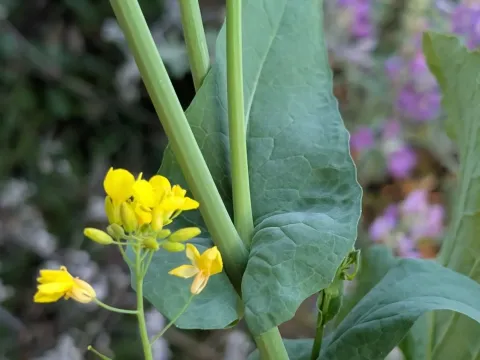
Napa cabbage
Brassica rapa L. subsp. chinensis (L.) Hanelt
Napa cabbage is a long-day plant, which makes the timing of planting critical to avoid bolting. It is best grown in two seasonal cycles: early spring or late summer to fall, to take advantage of cooler temperatures and specific day lengths.
What the section contains
Napa cabbage
For spring production, seeds are sown indoors or in protected structures in March or April. Selecting bolting-resistant varieties is essential, as the lengthening daylight hours during late spring stimulate the plant to produce a flower stalk prematurely.
The late summer to autumn cycle is often the most successful. Sowing occurs in late July or early August. As day lengths shorten during this period, the plant prioritizes foliage development and tight head formation over flowering.
Seeds should be sown at a depth of 1-1.5 cm. Utilizing a transplant method with starter trays or peat pots is highly recommended, as the cabbage root system is delicate and prone to stress from direct root disturbance during thinning or transplanting.
Providing a consistent environment for seedlings ensures uniform growth across the field. When transplanting, it is vital to keep the growing point above the soil surface to prevent fungal rot and encourage healthy, rapid development.
Napa cabbage belongs to the Brassicaceae family and thrives in well-drained, fertile loamy or sandy soils. It prefers a neutral pH range of 6.0 to 7.0, as acidic soil conditions significantly increase the risk of clubroot infections.
The plant is frost-tolerant and can survive minor drops in temperature down to -3-4 degrees Celsius. However, optimal head development occurs between 15 and 20 degrees Celsius, requiring careful monitoring in greenhouses.
Sufficient moisture is a key requirement for this crop. Soil should remain consistently damp, but avoid waterlogging at all costs, as excessive soil moisture promotes bacterial soft rot and suffocates the plant's delicate root system.
Effective crop rotation is mandatory. Napa cabbage should not be planted in soil previously occupied by other cruciferous vegetables (such as radishes, turnips, or other types of cabbage) for at least three to four years to break pest and disease cycles.
The crop requires intensive nutrition, particularly nitrogen during the early leaf-rosette stage. Potassium and phosphorus applications are crucial later in the growth cycle to ensure firm head density and improve overall plant hardiness.
Yields for Napa cabbage typically range between 40 and 80 tonnes per hectare, depending on the intensity of the management practices and the genetic potential of the chosen cultivar. Proper spacing is vital for maximizing productivity.
The percentage of marketable produce is highly dependent on effective disease management and regular irrigation. Top-tier hybrid seeds allow for a high degree of crop uniformity, which is critical for profitable commercial production.
The weight of a single head generally ranges from 0.5 to 2.5 kg. Selecting specific varieties for different market windows allows for a steady supply throughout the harvest season, optimizing both profit and operational efficiency.
Supplementing soil with essential micronutrients like boron and magnesium helps prevent common issues such as tip burn and structural weakness. These small inputs lead to higher density and improved consumer appeal of the final product.
Employing drip irrigation systems can boost yields by 20-30% by ensuring moisture is delivered exactly when the plant needs it, particularly during the critical stage of head development when water stress would otherwise cause low quality.
Clubroot (Plasmodiophora brassicae) is one of the most devastating soil-borne diseases. Management includes liming the soil to maintain an alkaline-neutral pH and strictly avoiding the repeated planting of Brassicas on the same site.
Bacterial soft rot and vascular wilt are also major threats, often exacerbated by high humidity and heat. These diseases can quickly rot the core of the head, rendering the crop entirely unsalable if not controlled through sanitation.
Pest pressures are significant, with flea beetles being the most destructive to young seedlings. Other common pests include aphids, cabbage moths, and cutworms, which damage leaf tissue and vector viral diseases throughout the field.
- Clubroot (Plasmodiophora brassicae)
- Bacterial soft rot (Pectobacterium carotovorum)
- Flea beetles (Phyllotreta spp.)
- Aphids (Brevicoryne brassicae)
A successful defense strategy involves an integrated approach combining biological pest controls, scheduled application of organic or synthetic insecticides, and the use of physical row covers to block pest access during the vulnerable seedling stage.
Harvesting should occur on a dry day once heads have achieved the appropriate firmness for the specific variety. Using a sharp knife, the heads are cut at the base, leaving the outer loose leaves to be trimmed in the field.
Timing the harvest is critical; delaying harvest beyond the point of maturity leads to head splitting, increased pest vulnerability, and reduced shelf life. Efficiency at this stage is key to maintaining quality and freshness.
Post-harvest care requires immediate cooling to remove field heat and slow down the plant's metabolic processes. Since the leaves are fragile, careful handling during transport is required to prevent bruising and long-term tissue damage.
When stored in professional cold-storage facilities at 0 to 1 degree Celsius with high humidity, Napa cabbage can remain in good condition for up to 3 months. Proper cleaning of the heads before storage is necessary to ensure longevity.
After the harvest, prompt incorporation or removal of crop residues is recommended. This cleanup minimizes the survival sites for pathogens and insect larvae, effectively reducing the disease pressure for the following season's plantings.