
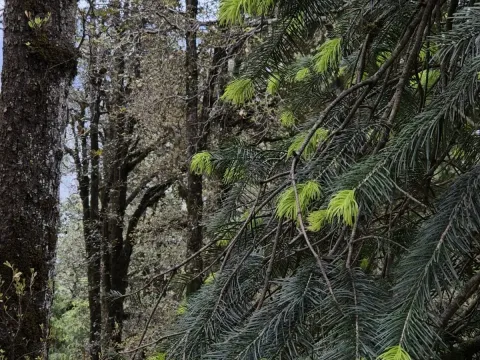
Pindrow fir
Abies pindrow
Propagation of Pindrow fir in forestry is primarily achieved through generative reproduction using seeds. Cones should be collected in the autumn before they begin to shed their scales.
What the section contains
Pindrow fir
Seed material requires stratification in a cool and moist environment to break dormancy and ensure high germination rates. Sowing is typically performed in early spring in prepared nursery beds.
The seeds are sown at a depth of 1-2 cm. Maintaining consistent soil moisture is crucial, while providing shade for young seedlings is essential to protect them from excessive sunlight.
Growth during the first few years is generally slow as the plant focuses on establishing a robust root system. Once the saplings reach 2-3 years of age, they are ready for transplanting to larger nursery plots.
Container-grown seedlings offer better control over environmental conditions, allowing for more precise management of the growth cycle and improved survival rates during reforestation efforts.
Pindrow fir belongs to the Pinaceae family and is native to the high-altitude forests of the Western Himalayas. It thrives in cool, humid climates, typically at elevations between 2,000 and 3,500 meters.
The species has specific soil requirements, preferring deep, well-drained, and nutrient-rich loamy soils. It is intolerant of waterlogged conditions, which can lead to root rot and mortality.
The tree requires protection from dry, hot winds, as it is highly sensitive to desiccation. Its naturally narrow, conical crown allows it to withstand heavy snowfall common in its native alpine range.
In landscape or plantation settings, providing adequate spacing is vital for the tree's health. Mulching around the base helps retain moisture and stabilizes soil temperatures during the growing season.
While mature trees are somewhat more tolerant of varying light levels, they perform best in semi-shaded to sunny locations with ample atmospheric moisture available throughout the year.
The economic value of Pindrow fir is largely centered on its wood production. In optimal forest conditions, it produces straight, high-quality timber suitable for construction and carpentry.
The wood is lightweight, soft, and easy to work with, making it a preferred choice for indoor furniture and decorative building elements. Regular thinning practices optimize yield and quality.
Sustainable forest management ensures a continuous cycle of biomass production. Proper care and selective harvesting allow for the maximization of timber output over the lifespan of the stand.
Beyond its timber utility, the species is appreciated in arboriculture for its aesthetic value. Its long, deep green needles and elegant form make it a desirable ornamental tree for parks.
Profitability is determined by the site's environmental quality and the effectiveness of silvicultural treatments applied throughout the tree's development phases.
Pindrow fir is susceptible to several pests, most notably aphids (Chermes) and spider mites, which feed on the foliage and sap of young shoots, potentially stunting growth.
Fungal pathogens, such as root rot and needle cast diseases, are common risks, especially in poorly drained soils. Prevention is key, focusing on maintaining proper aeration and hygiene.
Control measures include the application of systematic insecticides to manage pest populations and the use of fungicides to curb the spread of fungal spores in damp weather.
High-density plantations are more prone to disease outbreaks. Regular thinning and the removal of affected individuals are essential strategies for maintaining a healthy and resilient stand.
- Regular health monitoring of the canopy and bark.
- Sanitation pruning to remove dead or diseased limbs.
- Avoiding excessive overhead irrigation that promotes humidity.
Timber harvesting for Pindrow fir is carried out based on maturity cycles, often spanning several decades. The harvest must be managed according to long-term forestry plans.
Selective logging is often preferred to maintain forest health, removing only overmature or diseased trees. This approach minimizes soil disturbance and encourages natural regeneration.
Seed collection is performed during the cone-ripening season. Once collected, cones are processed to extract seeds, which are then cleaned and stored for future planting initiatives.
Post-harvest management is critical; logs must be processed or extracted promptly to prevent quality degradation caused by fungi or wood-boring insects in humid forest environments.
Effective harvest strategies include site restoration and replanting to ensure the longevity of the forest ecosystem and continuous provision of timber resources.