
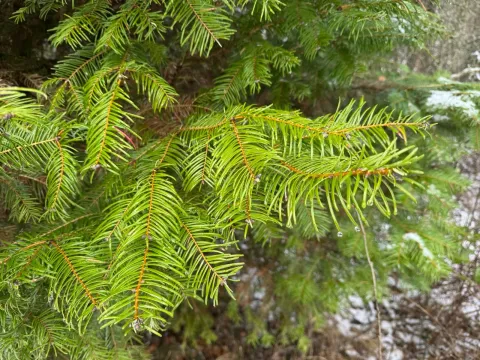
Fir
Abies
The sowing of fir seeds is typically conducted in autumn for natural stratification or in early spring following a 30 to 60-day cold stratification process at temperatures around +5°C.
What the section contains
 Arnold fir
Abies arnoldiana
Arnold fir
Abies arnoldiana
 Baishanzu fir
Abies beshuanzuensis
Baishanzu fir
Abies beshuanzuensis
 Beshanzu fir
Abies beshanzuensis
Beshanzu fir
Abies beshanzuensis
 Bristlecone fir
Abies bracteata
Bristlecone fir
Abies bracteata
 Bulgarian fir
Abies borisii-regis
Bulgarian fir
Abies borisii-regis
 Cheng fir
Abies chengii
Cheng fir
Abies chengii
 Delavay fir
Abies delavayi
Delavay fir
Abies delavayi
 Dense fir
Abies densa
Dense fir
Abies densa
 Durango fir
Abies durangensis
Durango fir
Abies durangensis
 East Himalayan fir
Abies spectabilis
East Himalayan fir
Abies spectabilis
 Fabri fir
Abies fabri
Fabri fir
Abies fabri
 Fanjingshan fir
Abies fanjingshanensis
Fanjingshan fir
Abies fanjingshanensis
 Farges fir
Abies fargesii
Farges fir
Abies fargesii
 Fir hybrids
Abies hybrids
Fir hybrids
Abies hybrids
 Flaky fir
Abies squamata
Flaky fir
Abies squamata
 Forrest fir
Abies forrestii
Forrest fir
Abies forrestii
 Guatemalan fir
Abies guatemalensis
Guatemalan fir
Abies guatemalensis
 Hickel's fir
Abies hickelii
Hickel's fir
Abies hickelii
 Kawakami fir
Abies kawakamii
Kawakami fir
Abies kawakamii
 Khingan fir
Abies nephrolepis
Khingan fir
Abies nephrolepis
 Manchurian fir
Abies holophylla
Manchurian fir
Abies holophylla
 Maries fir
Abies mariesii
Maries fir
Abies mariesii
 Min fir
Abies recurvata
Min fir
Abies recurvata
 Pindrow fir
Abies pindrow
Remarkable fir
Abies insignis
Sacred fir
Abies religiosa
Pindrow fir
Abies pindrow
Remarkable fir
Abies insignis
Sacred fir
Abies religiosa
 Shensi fir
Abies chensiensis
Vasconcellos fir
Abies vasconcellosiana
Shensi fir
Abies chensiensis
Vasconcellos fir
Abies vasconcellosiana
 Vejar fir
Abies vejarii
Vejar fir
Abies vejarii
 Vilmorin fir
Abies vilmorinii
Vilmorin fir
Abies vilmorinii
 Yuanbaoshan fir
Abies yuanbaoshanensis
Yuanbaoshan fir
Abies yuanbaoshanensis
Fir
In nursery settings, seeds are sown in loose, humus-rich soil, placed at a depth of 2 to 3 centimeters to ensure optimal moisture retention during the critical germination phase.
Maintaining consistent soil moisture is crucial, as young fir seedlings are highly sensitive to surface desiccation during their first weeks of development.
Due to the relatively low germination energy of fir seeds, agricultural standards recommend increasing the sowing rate by 20–30 percent to achieve desired density.
In forestry, two-year-old transplants are often preferred over direct seeding, as they provide significantly higher survival rates when outplanted to permanent sites.
The fir tree (genus Abies) belongs to the Pinaceae family, characterized by its evergreen nature and a preference for cool, moist climates with consistent atmospheric humidity.
Cultivation requires deep, fertile, loamy or sandy soils with excellent drainage, as the species is highly susceptible to root damage caused by stagnant water.
Most Abies species thrive in temperate zones and possess high frost resistance, though they require protection from dry, harsh winds that can desiccate the needles.
Fir trees are extremely sensitive to urban air pollution, smoke, and sulfur dioxide, which restricts their successful cultivation in industrial or densely populated urban areas.
Proper site selection must include light shade for young plants, as intense direct sunlight can inhibit initial growth and cause heat stress in saplings.
Fir wood is widely utilized in construction, joinery, and the paper industry because it is lightweight, soft, and lacks resin ducts, making it easy to process.
The needles and young twigs serve as raw materials for essential oils, which are highly valued in the pharmaceutical, cosmetic, and aromatherapy industries.
Ornamentally, the fir is highly sought after for its symmetrical pyramidal shape and upright-growing cones, which enhance the aesthetic value of public and private landscapes.
The species provides significant ecological benefits, including the release of high levels of phytoncides that improve air quality and help suppress airborne pathogens.
The economic value of fir cultivation is high, particularly for timber production and the Christmas tree market, which relies on its lush, non-shedding foliage.
The fir woolly aphid (Adelges spp.) is a primary pest that sucks sap from the needles, leading to chlorosis, stunted growth, and potential tree mortality if untreated.
Root rot, often associated with soil pathogens, remains a critical threat, especially in sites where drainage is inadequate and soil compaction occurs.
Needle cast diseases, caused by various fungi, can lead to widespread defoliation, particularly during years with prolonged spring humidity and cool temperatures.
Effective management involves a combination of integrated pest management (IPM), including the use of systemic insecticides and site-specific fungicide applications.
- Regular inspection for aphid clusters.
- Implementation of proper soil drainage systems.
- Sanitation pruning to remove infected branches.