
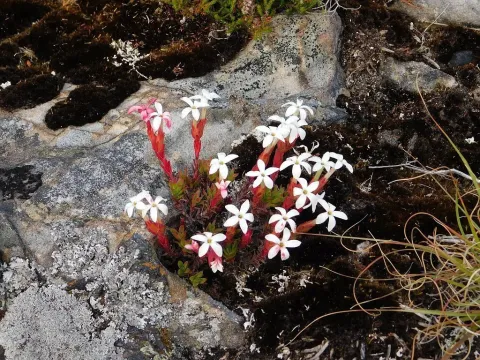
Crassula
Crassula L.
Crassula is a diverse genus of succulent plants belonging to the Crassulaceae family, primarily native to the arid regions of Southern Africa. These plants are characterized by their thick, fleshy leaves designed to store water, which allows them to thrive in harsh environments with irregular rainfall.
What the section contains
 Crassula capitella
 Thunb.
Crassula capitella
Crassula capitella Thunb.
 Crassula coccinea
 L.
Crassula coccinea
Crassula coccinea L.
 Crassula elegans
 Schönland & Baker f.
Crassula elegans
Crassula elegans Schönland & Baker f.
 Crassula elegans namibensis
Crassula elegans Schönland & Baker f. subsp. namibensis (Friedrich) Toelken
Crassula elegans namibensis
Crassula elegans Schönland & Baker f. subsp. namibensis (Friedrich) Toelken
 Crassula mesembryanthoides
 (Haw.) D. Dietr.
Crassula mesembryanthoides
Crassula mesembryanthoides (Haw.) D. Dietr.
 Crassula mesembryanthoides hybrid
Crassula mesembryanthoides (Haw.) D. Dietr. x Crassula rupestris Thunb.
Crassula mesembryanthoides hybrid
Crassula mesembryanthoides (Haw.) D. Dietr. x Crassula rupestris Thunb.
 Crassula nudicaulis
 L.
Crassula nudicaulis cross
Crassula nudicaulis L. x Crassula perfoliata L.
Crassula nudicaulis
Crassula nudicaulis L.
Crassula nudicaulis cross
Crassula nudicaulis L. x Crassula perfoliata L.
 Crassula pubescens
 Thunb.
Crassula pubescens
Crassula pubescens Thunb.
 Crassula rubricaulis
 Eckl. & Zeyh.
Crassula rubricaulis
Crassula rubricaulis Eckl. & Zeyh.
 Crassula rupestris
 Thunb.
Crassula rupestris
Crassula rupestris Thunb.
 Crassula swaziensis
 Schönland
Crassula swaziensis
Crassula swaziensis Schönland
 Jade plant
Crassula ovata (Mill.) Druce
Jade plant
Crassula ovata (Mill.) Druce
 Propeller plant
Crassula perfoliata L.
Propeller plant
Crassula perfoliata L.
 Schmidt's Crassula
Crassula schmidtii Regel
Schmidt's Crassula
Crassula schmidtii Regel
 Silver Dollar Plant
Crassula arborescens (Mill.) Willd.
Silver Dollar Plant
Crassula arborescens (Mill.) Willd.
 Watch chain plant
Crassula muscosa L.
Watch chain plant
Crassula muscosa L.
Crassula
The plant requires bright, indirect light for optimal development, as direct harsh sunlight can often scorch the foliage. During the growing season, a temperature range between 20 and 25 degrees Celsius is ideal, while a cooler dormant period during winter helps maintain the health and structural integrity of the plant.
Soil composition must prioritize drainage, as Crassula plants are highly susceptible to root rot caused by waterlogged substrates. A professional-grade succulent or cactus mix, amended with sand, perlite, or pumice, ensures the rapid drainage necessary for healthy root development.
Irrigation should be managed through a "soak and dry" cycle, meaning the soil must be completely dry before the next watering session begins. Overwatering is the most common cause of failure in Crassula cultivation, leading to rapid decay of the vascular tissues at the base of the stem.
Propagation is typically performed via stem or leaf cuttings, which demonstrate high survival rates when placed in well-draining, slightly moist soil. This method is the standard commercial approach for producing large quantities of uniform stock plants for sale or greenhouse expansion.
The primary threats to Crassula plants are fungal pathogens, specifically those causing root and stem rot triggered by excessive moisture and poor soil aeration. If decay is observed, immediate reduction of watering and partial excision of the infected tissue may be necessary to salvage the plant.
Pest pressures primarily include mealybugs, spider mites, and scale insects, all of which thrive in dry indoor climates. These pests feed on the nutrient-rich sap, causing leaf spots, stunted growth, and in severe infestations, the complete decline of the plant’s health.
Management of these pests requires the use of targeted systemic insecticides or horticultural oils, applied with care to ensure full coverage of the plant’s crevices. Physical removal using a cotton swab dipped in alcohol is effective for small-scale infestations or individual household plants.
Preventative maintenance is essential, involving regular inspection of leaf axils and the undersides of leaves to identify early signs of colonization. Ensuring adequate spacing between plants and maintaining good airflow significantly reduces the likelihood of pest outbreaks and fungal spores spreading.
Cultivators must prioritize environmental hygiene, removing dead leaves and debris from the surface of the growing medium. By maintaining strict control over environmental parameters such as humidity and light, the plant’s natural resistance to diseases is greatly enhanced throughout its life cycle.