
Jade plant
Crassula ovata (Mill.) Druce
Description
Growing requirements
The jade plant (Crassula ovata) is a succulent shrub belonging to the Crassulaceae family. Native to the Eastern Cape and KwaZulu-Natal provinces of South Africa, it is a drought-tolerant species adapted to rocky, arid environments.
Botanically, the plant features fleshy, glossy green leaves that may develop red margins when exposed to intense light. The stems are thick and woody, providing structural support as the plant matures into a miniature tree-like shape.
Cultivation requires well-draining soil, typically a mix designed for cacti and succulents. This ensures that excess water drains quickly, preventing root asphyxiation, which is the primary cause of failure in succulent horticulture.
Light intensity is a critical requirement. The species performs best under full sun or bright indirect light. Insufficient light leads to etiolation, where the plant develops weak, elongated stems and loses its characteristic compact form.
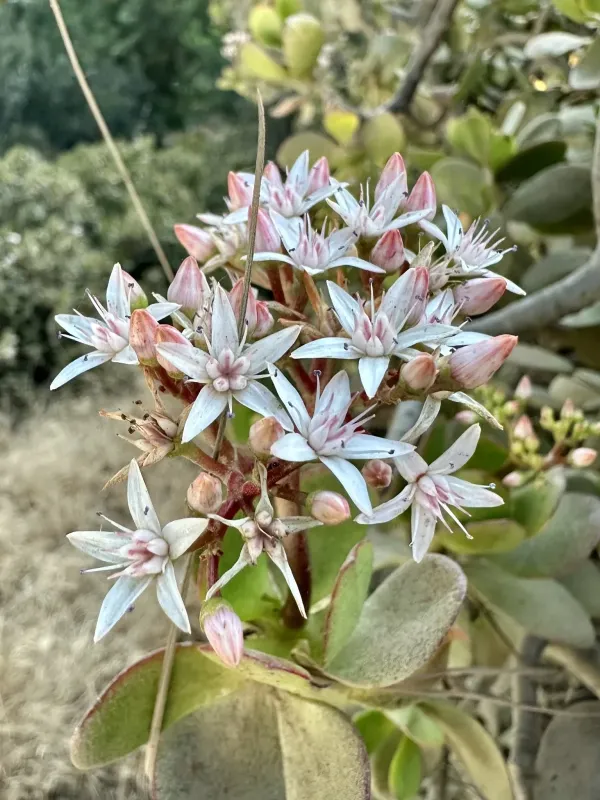
Temperature management involves keeping the plant in the range of 15°C to 25°C during the growing season. A brief cooling period in winter, with temperatures dropping near 10°C, can encourage the development of star-shaped, white or pink flowers.
Main diseases and pests
Root rot caused by Phytophthora or Pythium species is the most significant threat to Crassula ovata. This is almost exclusively associated with overwatering or poor drainage, leading to the rapid decay of the vascular tissues.
Mealybugs are the most common insect pests, feeding on the sap and secreting honeydew. They congregate in the leaf axils and on the undersides of leaves, requiring manual removal or systematic pesticide applications.
Scale insects can form small, hard brown bumps on the stems and leaves, extracting nutrients and weakening the plant. Control is best achieved by systemic insecticides or using oils specifically labeled for succulent plant treatment.
Spider mites represent a risk, particularly in environments with poor air circulation and low humidity. These pests cause yellowing and stippling of the leaf surface, which can be mitigated by increasing humidity levels and using acaricides.
Maintaining a clean growing environment is vital. Regularly removing dead leaves from the soil surface helps reduce the risk of secondary infections and provides a better overall sanitary condition for the plant population.