
Crassula rubricaulis
Crassula rubricaulis Eckl. & Zeyh.
Description
Growing requirements
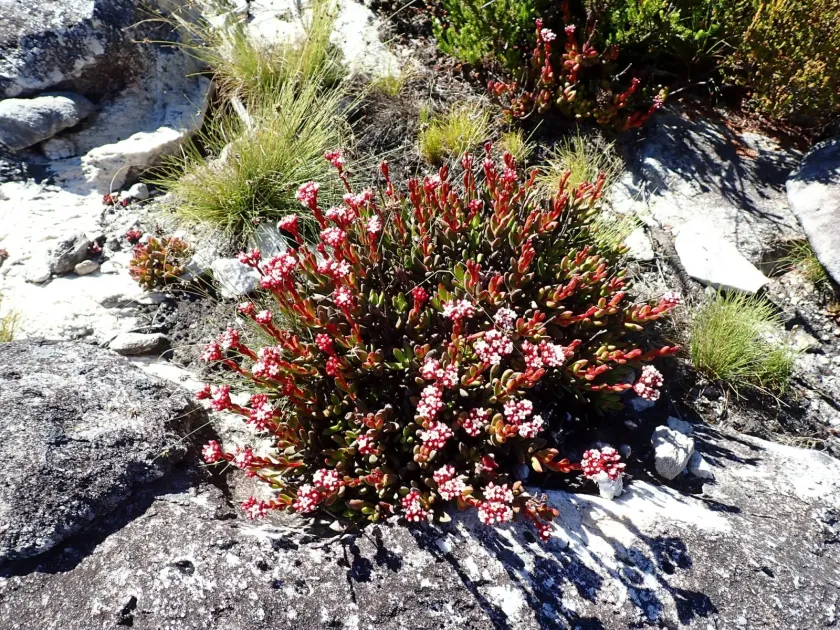
Crassula rubricaulis is a charming succulent species belonging to the Crassulaceae family, native to the arid landscapes of the Cape Province in South Africa. Known for its distinct reddish stems and fleshy leaves, this plant is a popular choice for collectors seeking resilient and ornamental succulents.
The primary requirement for this culture is intense, indirect sunlight. To maintain its compact shape and vibrant leaf coloration, the plant should be placed in a south or west-facing window. Insufficient light levels will lead to etiolation, a process where stems become thin and leggy as they stretch toward a light source.
Regarding soil, Crassula rubricaulis demands a fast-draining substrate. A standard mix for cacti and succulents, supplemented with pumice, grit, or coarse sand, is ideal. The pot must have ample drainage holes to prevent water from pooling at the base, as excessive moisture is the leading cause of plant loss.
Watering practices should follow the soak-and-dry method. During the active growing season, water thoroughly only when the soil has completely dried out. In the winter months, the plant enters a semi-dormant phase, requiring very little moisture to survive. Overwatering during this time is particularly detrimental to the root system.
Regular fertilization is beneficial during the active growth period, typically from spring through summer. Use a balanced, water-soluble fertilizer formulated for succulents at half the recommended concentration. Avoid nitrogen-heavy fertilizers, as they can cause the plant to grow too quickly and weaken its cell structure.
Main diseases and pests
Root rot is the most common threat to Crassula rubricaulis, usually caused by improper watering and heavy, non-porous soil. Signs include mushy, discolored stems and leaves falling off prematurely. If spotted early, remove the plant, trim away rotting roots, and repot it in fresh, dry, porous media.
Mealybugs are a frequent pest, appearing as white, cottony masses in the leaf axils. These pests feed on sap and can stunt growth. They can be effectively controlled by dabbing the affected areas with isopropyl alcohol or using systemic insecticides suitable for indoor plant care.
Spider mites may infest the plant in environments with low humidity. These microscopic pests create fine webs and cause yellow spotting on the foliage. To prevent them, maintain good air circulation and mist the surrounding air occasionally, or use an effective acaricide if an infestation occurs.
Scale insects can also attach themselves to the stems, appearing as small, brown, bump-like growths. Because they are protected by a hard outer shell, systemic treatments are usually required to eliminate them. Manual removal with a soft brush followed by an insecticidal spray is also a recommended strategy.
Fungal infections can occur if the plant is kept in humid, stagnant air without proper ventilation. These typically manifest as dark or blotchy spots on the leaves. Increasing airflow, keeping foliage dry, and applying copper-based fungicides can help manage and stop the spread of such fungal issues.