
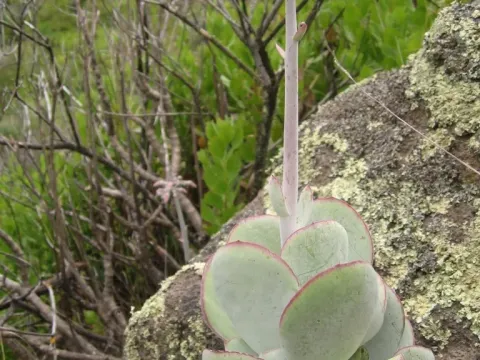
Cotyledon
Cotyledon L.
Cotyledon (Cotyledon L.) is a genus of perennial succulent plants belonging to the Crassulaceae family. Native to the arid regions of Southern Africa and the Arabian Peninsula, these plants have evolved specific physiological adaptations to thrive in harsh environments with irregular rainfall.
What the section contains
 Bear's Paw
Cotyledon tomentosa Harv.
Bear's Paw
Cotyledon tomentosa Harv.
 Cotyledon campanulata hybrid
Cotyledon campanulata Marloth x C. pendens van Jaarsv.
Cotyledon campanulata hybrid
Cotyledon campanulata Marloth x C. pendens van Jaarsv.
 Cotyledon eliseae
 van Jaarsv.
Cotyledon eliseae
Cotyledon eliseae van Jaarsv.
 Cotyledon eliseae x orbiculata
Cotyledon eliseae van Jaarsv. x Cotyledon orbiculata L.
Cotyledon eliseae x orbiculata
Cotyledon eliseae van Jaarsv. x Cotyledon orbiculata L.
 Cotyledon orbiculata
 L.
Cotyledon orbiculata
Cotyledon orbiculata var. oblonga (Haw.) DC.
Cotyledon orbiculata
Cotyledon orbiculata L.
Cotyledon orbiculata
Cotyledon orbiculata var. oblonga (Haw.) DC.
 Cotyledon papillaris
 L. f.
Cotyledon pendens x tomentosa
Cotyledon pendens van Jaarsv. x C. tomentosa Harv.
Hybrid of Cotyledon orbiculata and Cotyledon papillaris
hybrids between Cotyledon orbiculata L. and Cotyledon papillaris L. f.
Cotyledon papillaris
Cotyledon papillaris L. f.
Cotyledon pendens x tomentosa
Cotyledon pendens van Jaarsv. x C. tomentosa Harv.
Hybrid of Cotyledon orbiculata and Cotyledon papillaris
hybrids between Cotyledon orbiculata L. and Cotyledon papillaris L. f.
 Hybrid of Cotyledon orbiculata and Cotyledon papillaris
hybrids between Cotyledon orbiculata L. var. oblonga (Haw.) DC. and Cotyledon papillaris L. f.
Hybrid of Cotyledon orbiculata and Cotyledon papillaris
hybrids between Cotyledon orbiculata L. var. oblonga (Haw.) DC. and Cotyledon papillaris L. f.
Cotyledon
Botanically, they are characterized by their fleshy, succulent leaves often coated with a powdery bloom or dense hairs, which help to reflect excessive sunlight and reduce transpiration. The plant structure can vary from small ground-hugging forms to larger woody-based shrubs.
Climate requirements for Cotyledon involve high light intensity and moderate to warm temperatures. In cultivation, they perform best in well-drained, porous soils that mimic their natural rocky habitats. It is essential to ensure the growing medium dries out completely between watering sessions.
Agronomic management relies on providing excellent airflow and protection from freezing temperatures, as most species are not frost-hardy. Proper light exposure is crucial, as inadequate light leads to etiolation, where the plant grows weak, spindly, and loses its structural integrity.
The primary use of Cotyledon is ornamental. They are highly valued by collectors and landscape designers for their unique architectural forms, drought tolerance, and longevity. They are frequently used in xeriscaping projects and indoor container gardening in various climates worldwide.
The most common threat to Cotyledon health is overwatering, which quickly leads to root and stem rot. Because succulents store water in their tissues, they are highly susceptible to pathogens in soggy environments where the roots cannot breathe.
Mealybugs are the most persistent pests affecting these plants, often nesting in the tight spaces between leaf axils. If left untreated, they can cause significant stunted growth and leaf drop, significantly detracting from the plant's aesthetic value.
Spider mites can also be a problem, especially during winter months when indoor heating causes the air to become very dry. These tiny pests extract sap from the leaves, leaving behind pale spots and fine webbing on the plant's surface.
To maintain plant health, it is vital to practice good hygiene, such as removing dead leaves and monitoring for signs of infestation regularly. Using sterile, well-draining potting mixtures significantly reduces the risk of fungal infections.
In case of pest infestation, horticultural soaps or systemic insecticides can be effective. However, the most effective strategy remains the maintenance of optimal environmental conditions, as healthy, stress-free plants are more resistant to pest attacks.