
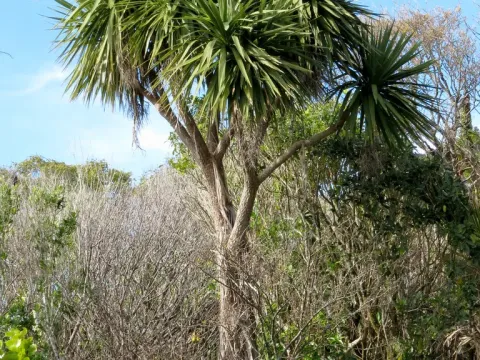
Cordyline
Cordyline Comm. ex Juss.
Cordyline is a genus of perennial flowering plants in the family Asparagaceae. Naturally found in the tropical and subtropical regions of the Pacific, Asia, and Australia, these plants are highly valued for their architectural foliage and vibrant colors.
What the section contains
 Brazilian Cordyline
Cordyline brasiliensis
Brazilian Cordyline
Cordyline brasiliensis
 Cabbage tree
Cordyline australis (G. Forst.) Endl.
Cabbage tree
Cordyline australis (G. Forst.) Endl.
 Cordyline australis x banksii
Cordyline australis x cordyline banksii
Cordyline australis x banksii
Cordyline australis x cordyline banksii
 Cordyline banksii
 Hook. f.
Cordyline banksii
Cordyline banksii Hook. f.
 Cordyline banksii and Cordyline pumilio hybrids
Hybrids between Cordyline banksii and Cordyline pumilio
Cordyline banksii and Cordyline pumilio hybrids
Hybrids between Cordyline banksii and Cordyline pumilio
 Cordyline baueri
 Hook. f.
Cordyline baueri
Cordyline baueri Hook. f.
 Cordyline fruticosa
 (L.) A. Chev.
Cordyline fruticosa
Cordyline fruticosa (L.) A. Chev.
 Cordyline kaspar
 W.R.B. Oliv.
Cordyline kaspar
Cordyline kaspar W.R.B. Oliv.
 Cordyline pumilio
 Hook. f.
Cordyline pumilio
Cordyline pumilio Hook. f.
 Mountain Cabbage Tree
Cordyline indivisa (G. Forst.) Steud.
Mountain Cabbage Tree
Cordyline indivisa (G. Forst.) Steud.
Cordyline
The plant requires bright, indirect sunlight to thrive. Excessive exposure to direct sun can result in scorched leaf edges and stunted growth, while lack of light leads to loss of variegation in species that have colored foliage.
Soil requirements involve a well-draining, nutrient-rich potting mix with a slightly acidic pH. Proper drainage is essential to prevent waterlogging, which is the primary cause of root rot in agricultural settings.
Temperature management is critical; Cordylines prefer moderate temperatures between 18°C and 25°C. Exposure to cold drafts or temperatures below 10°C can cause significant physiological stress and leaf drop.
Humidity levels should remain consistently high, typically above 60%. Regular misting or the use of humidity trays helps maintain the plant's health, ensuring that leaf tips do not turn brown or brittle.
Scale insects are frequent pests that attach themselves to the stems and leaves, extracting vital plant sap. Their presence often causes yellowing of the foliage and the development of sooty mold due to honeydew secretions.
Spider mites represent a major threat in indoor or greenhouse environments, especially where ventilation is poor. These pests pierce the leaf tissue, leading to mottled appearance and eventually causing the leaves to dry out completely.
Mealybugs are often hidden in the crevices where leaves meet the stem. They produce a waxy white substance that protects them from direct contact with pesticides, making manual removal and systemic treatment necessary for full control.
Root rot, caused by various oomycetes and fungi, is a devastating issue resulting from improper irrigation practices. Symptoms include wilting, dark mushy roots, and a foul odor emanating from the soil substrate.
Leaf spot diseases, characterized by brown or black necrotic patches, occur when foliage remains wet for extended periods. Maintaining foliage dryness and ensuring good air movement are the primary preventative measures for such infections.