
Pink rot
Trichothecium roseum
Description
Symptoms
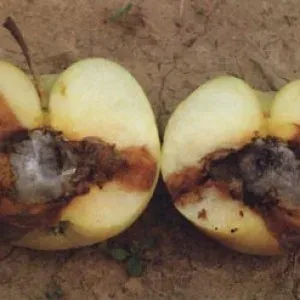
The first symptoms typically appear as small, slightly sunken, brownish spots on the surface of the affected fruit or vegetable. These spots gradually expand in size.
The most distinctive feature of the disease is the development of a white, then salmon-pink, dusty mycelial mat over the center of the lesions. This mass of fungal spores is diagnostic for T. roseum.
Beneath the fungal growth, the fruit tissue becomes soft and eventually decays. In apples and pears, the rot often develops internally, starting from the calyx end.
For crops like celery or beans, lesions occur on petioles and pods, leading to water-soaked necrotic areas that eventually become covered in pink spore masses.
Affected plant parts may exhibit stunted growth, wilting, and eventual death. In hemp, the fungus can cause significant damage to stems, resulting in discoloration and reduced fiber quality.
Pathogen
The causative agent of this disease is the imperfect fungus Trichothecium roseum (Pers.) Link. It is a cosmopolitan fungus known for its saprophytic nature and weak parasitic capabilities.
The fungus produces a light pink or salmon-colored mycelium that consists of simple conidiophores. These conidiophores bear characteristic two-celled, hyaline conidia at their tips.
The pathogen reproduces rapidly through these conidia, which are easily dispersed by wind, splashing rain, or contact. It can thrive on a wide variety of organic substrates, including decaying plant tissue.
Biologically, it is highly adaptable to various environmental conditions. Its ability to produce enzymes allows it to penetrate plant cell walls, leading to rapid tissue maceration.
The fungus is often found as a secondary invader, colonizing tissue that has already been weakened by mechanical damage or primary infections, such as scab or fire blight.
Conditions for development
The development of Pink rot is highly dependent on environmental moisture. High relative humidity (above 85–90%) is required for the fungus to sporulate and infect host tissues.
Temperatures between 20°C and 25°C are ideal for rapid colonization, but the fungus remains active in a wide temperature range, making it a threat even in cold storage facilities.
Mechanical injuries, such as bruises from harvesting or punctures by insects, are the primary entry points for the fungus. Without these wounds, infection is significantly less frequent.
Poor ventilation and overcrowded storage conditions facilitate the spread of spores from infected produce to healthy ones, leading to rapid storage losses.
Wet weather during the ripening stage of fruits such as watermelon or avocado significantly increases the risk of pre-harvest infection, as the spores are spread via rain splashes.
Why it matters
Pink rot causes significant economic losses by reducing both the quality and quantity of marketable produce. It is a major concern for both field crops and post-harvest storage.
A broad range of crops are susceptible to the disease:
- Apple
- Pear
- Watermelon
- Avocado
- Celery
- Common bean
- Hemp
- Peach
Fruits infected with the fungus develop a characteristic bitter taste, making them completely unmarketable for processing or fresh consumption.
In addition to direct losses, the cost of labor for sorting and discarding infected produce during grading significantly impacts the bottom line of agricultural enterprises.
If not managed correctly in storage, the fungus can cause devastating losses, potentially ruining entire batches within a few weeks due to the rapid spread of airborne spores.
Protection
The foundation of control is strict field sanitation. Removing and destroying plant debris from the field reduces the primary inoculum for the next season.
Applying fungicides during the growing season is necessary in high-risk environments, particularly if the weather is warm and humid during the maturation of fruits.
Effective post-harvest management includes maintaining low humidity and proper air circulation in storage units. Refrigeration should be monitored to prevent condensation on fruit surfaces.
Protecting crops from insect damage and physical wounds during the growing season is crucial, as intact fruit is significantly more resistant to fungal penetration.
Careful harvesting and grading are essential. Fruits with even minor scratches or bruises should not be stored with healthy produce to prevent cross-contamination.
In brief
9
Affects crops
Biology
Pathogens and affected parts
Pathogens
Affected plant parts
whole plant
Content graph
Affects crops · 9
Content graph
Connections · Pink rot
Most often together:
Marketplace
Products · 82



Extra Early Gold F1
Unigen Seeds (United Genetics)
Onion
1
0
·
2.1K
8 offers
0.76 €per 1000 seeds
Buy





Gold Star
MARALDI SEMENTI S.A.S. DI MARALDI DANIELE
Onion
0
0
·
40
6 offers
0.24 €per 1000 seeds
Buy


PRIMO BLANCO
MARALDI SEMENTI S.A.S. DI MARALDI DANIELE
Onion
0
0
·
31
4 offers
0.71 €per 1000 seeds
Buy


Community
Discussion
No discussions yet — be the first.