
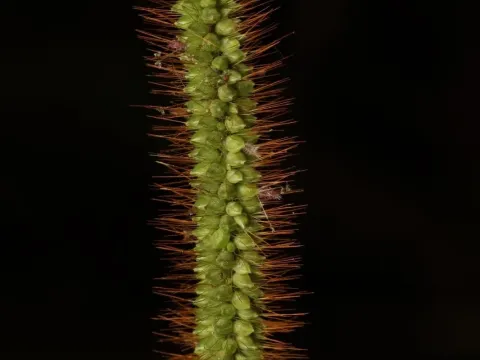
Yellow foxtail
Setaria pumila (Poir.) Roem. & Schult.
Yellow foxtail is a warm-season grass, meaning it thrives when soil temperatures reach 12–14°C. The ideal sowing time is late spring, once the threat of frost has passed, as cold soil significantly hampers germination and initial seedling vigor.
What the section contains
Yellow foxtail
Seeds of this species exhibit high viability and can successfully emerge from depths of up to 5–8 centimeters. Early planting into cold, wet soil often results in uneven emergence and leaves the crop vulnerable to competition from more aggressive weeds.
To establish productive stands for forage, uniform seed distribution is critical. The seeding rate should account for the plant's natural tendency to tiller, which allows it to form dense stands when given enough space to develop its root and leaf systems.
Field preparation requires a well-tilled, level seedbed to ensure consistent contact between the seed and soil particles. Planting is typically done in rows, which facilitates mechanical weeding and promotes better airflow throughout the canopy during the growing season.
High-quality, certified seed free from impurities is essential for successful cultivation. Proper depth control during sowing ensures that the emerging seedlings have enough energy reserves to establish a robust root system before the onset of summer heat.
As a member of the Poaceae family, yellow foxtail is highly sensitive to temperature. It requires significant cumulative heat units for optimal growth, making it well-suited for regions with long, hot summers and high levels of solar radiation.
While the plant shows plasticity across various soil types, it performs best in fertile, well-aerated soils. It grows adequately in loams and sandy soils, provided that there is sufficient organic matter to support its rapid biomass accumulation.
Yellow foxtail is recognized for its impressive drought tolerance, which makes it a resilient choice in areas with inconsistent rainfall. However, to achieve maximum yield potential, regular moisture is necessary during critical vegetative stages.
Agronomic management involves periodic inter-row cultivation to prevent soil crusting and improve aeration. This practice is vital for nutrient uptake, especially in heavier soils where compaction can restrict root penetration and overall plant development.
Balanced fertilization, particularly with nitrogen during the early stages, is recommended to boost leaf production. Providing the right nutrients allows the plant to outcompete weeds and reach its peak growth velocity before the heat of midsummer.
The yield of yellow foxtail is highly dependent on management intensity and environmental conditions. Under optimal conditions, the plant can generate substantial green biomass, which is often used as a source of supplementary forage for livestock.
Productivity is largely determined by the timing of key management practices, including fertilization and effective pest control. With appropriate moisture management, yields can be significantly increased to meet the demands of intensive farming operations.
Timing the harvest is crucial because the nutritional value of the plant declines rapidly once it transitions to the reproductive phase. Harvesting before the stems become overly lignified ensures a higher protein and sugar content for animal feed.
Seed production is prolific, which is a factor to consider in long-term crop rotation. Given the high number of seeds produced per plant, management should focus on limiting seed bank accumulation to maintain the integrity of future crop cycles.
Optimizing plant density is key to maximizing biomass yield. Overcrowded stands may suffer from lodging, while overly sparse stands fail to capture the available light and soil nutrients efficiently, resulting in suboptimal total yield per hectare.
Like many other grasses, yellow foxtail is susceptible to common diseases such as rusts and various foliar spots. These pathogens can diminish the photosynthetic capacity of the leaves, directly impacting the final yield and plant health.
Insect pests, including cereal flies and leafhoppers, can cause significant damage to young seedlings. During outbreaks, economic damage may necessitate the use of targeted insecticides to protect the stand during the delicate early growth stages.
Effective disease management relies on sound crop rotation practices. Avoiding the cultivation of yellow foxtail immediately after other cereal crops helps break the infection cycle of soil-borne pathogens and reduces the overall disease pressure.
Weed competition can be a major limiting factor in yield. Implementing selective herbicide programs or timely mechanical weeding helps maintain crop purity and reduces the stress that often predisposes the plants to secondary infections.
Regular field scouting is an essential practice for early detection of potential threats. Monitoring the canopy for early symptoms of pests or diseases allows for timely intervention, minimizing the need for heavy chemical applications.
The harvest for forage should be conducted before the onset of mass flowering. During this vegetative window, the plant provides the highest nutritional quality, containing optimal concentrations of proteins and minerals for animal consumption.
Harvesting is performed using standard mowing equipment, followed by immediate processing. If intended for hay or silage, ensuring rapid drying or proper fermentation is essential to preserve the nutritional value of the harvested material.
For seed production, harvesting must occur only after the seeds have reached full maturity. Care should be taken to minimize shattering, as the seeds have a natural tendency to drop from the panicle once they are completely ripe.
Modern harvesting machinery must be correctly calibrated to handle the small seeds of the yellow foxtail. Adjusting the threshing drum speed and air flow is necessary to prevent mechanical damage and ensure a clean, high-quality seed sample.
Post-harvest conditioning includes drying the seeds to a safe moisture level and thorough cleaning. Storing seeds in cool, dry conditions is imperative to maintain high germination rates for future planting seasons and ensure field performance.