
Setaria nigrirostris
Setaria nigrirostris (Nees) Dur. et Schinz
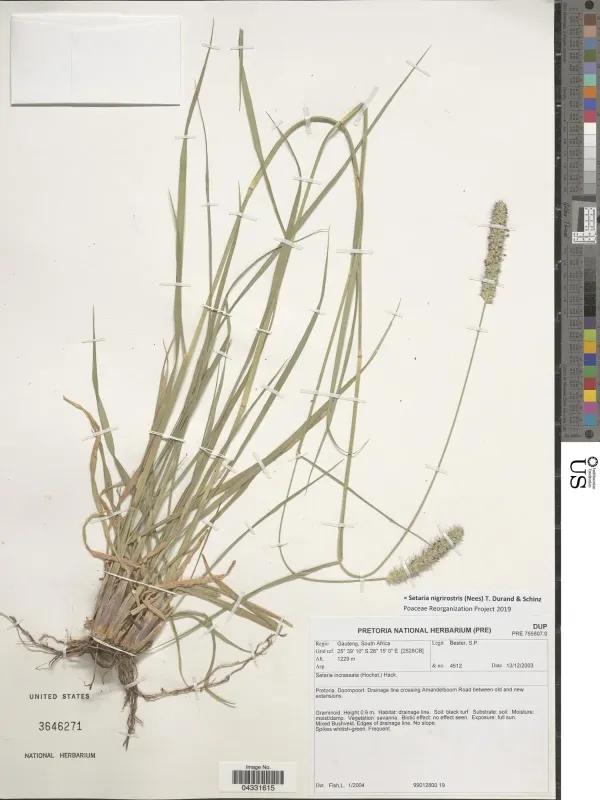
Description
Sowing dates
Setaria nigrirostris is a warm-season grass that requires sufficiently warmed soil to germinate, typically necessitating sowing in late spring or early summer.
Precise seed placement is vital, with an ideal sowing depth of two to three centimeters to ensure moisture availability and protection from environmental stress.
The standard seeding rate is generally between ten and fifteen kilograms per hectare, depending on local soil conditions and the intended density of the sward.
Row planting with spacing of fifteen to twenty centimeters is recommended to allow for easier weeding and better resource distribution among young plants.
It is important to avoid delayed sowing, as the crop needs to establish a strong root system before the onset of extreme summer heat in arid climates.
Growing requirements
This crop performs exceptionally well on well-drained sandy or loamy soils, showing resilience in environments where other fodder species might struggle.
Setaria nigrirostris is known for its notable drought tolerance, making it a reliable option for regions characterized by erratic rainfall patterns.
Sunlight is a crucial requirement for optimal development; therefore, fields should be selected that are free from heavy shading by trees or tall structures.
Strategic nitrogen fertilization significantly boosts biomass production, particularly during the active growth phases following initial establishment.
Soil pH should ideally remain in the slightly acidic to neutral range to facilitate nutrient uptake and support a vigorous, healthy crop stand.
Yield
Productivity levels depend heavily on management practices and moisture availability, with a maximum yield potential achievable under favorable conditions.
Farmers can expect to harvest between twenty and thirty tonnes of fresh biomass per hectare, contributing significantly to annual forage requirements.
Multiple harvests are possible within a single season, with the number of cuts dependent on the length of the growing period and regional climatic factors.
The nutritional profile of the harvested fodder, including its protein content, makes it a highly desirable addition to livestock feeding programs.
Maximizing yields requires a proactive approach to soil health and fertility management, ensuring that plants have access to essential nutrients throughout the cycle.
Main diseases and pests
Fungal diseases, especially those thrive in high humidity conditions, represent a major risk that needs to be managed through field monitoring.
Young seedlings are frequently susceptible to cereal pests such as flea beetles, which can cause significant damage if left untreated during the early stages.
Weed control is essential during the early developmental phases, as the crop can be outcompeted if field sanitation measures are neglected during sowing.
Integrated pest management strategies should be applied to minimize chemical dependency and maintain the overall balance within the agricultural ecosystem.
Rotating fields with other crops helps mitigate the buildup of soil-borne pathogens and pests, ensuring long-term field productivity and soil vitality.
Harvesting
The optimal harvest window occurs at the anthesis or heading stage, when nutrient density in the foliage is at its absolute peak for nutritional value.
Efficient harvesting techniques involve the use of mowers and forage harvesters, ensuring quick biomass collection to preserve quality during processing.
Proper wilting and drying processes are necessary if the harvested material is destined for hay production, protecting against loss of vitamins and proteins.
When ensiling, ensuring appropriate compaction and sealing is critical to achieving high-quality fermented feed that retains its value throughout the winter.
Leaving a proper stubble height during mowing protects the plant crown, which is essential for promoting regrowth and sustaining the grass over multiple years.