
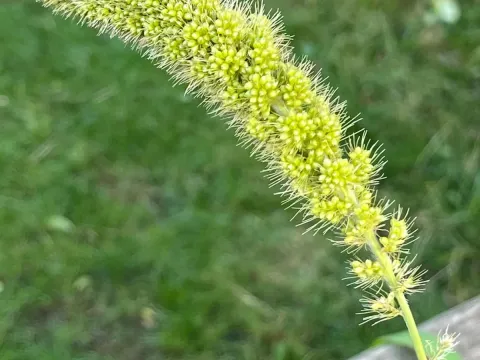
Foxtail millet
Setaria italica (L.) P. Beauv. subsp. italica
Sowing foxtail millet requires well-warmed soil, as the crop is highly sensitive to cold temperatures. The ideal planting time occurs when soil temperatures reach +12...14°C at seeding depth.
What the section contains
Foxtail millet
Early sowing is generally encouraged to utilize stored winter moisture, which is critical for the crop's establishment in semi-arid regions where rainfall is unpredictable during the spring.
For grain production, standard row seeding with 15 cm spacing is commonly employed to ensure uniform density and efficient resource uptake during the growth cycle.
Seed depth should be maintained between 2 and 4 cm. Excessive depth in heavy soils can significantly delay emergence and result in uneven stands, which complicates later management stages.
Post-sowing rolling is recommended to consolidate the seedbed, ensuring optimal contact between the seed and soil particles, which promotes faster germination and uniform seedling development.
Foxtail millet, belonging to the Poaceae family, is a warm-season grass that thrives in high temperatures and intense sunlight. It is exceptionally well-adapted to hot and dry environments.
The plant's main agronomic strength is its superior drought tolerance compared to other cereal crops. Its deep root system allows it to survive periods of limited rainfall effectively.
Soil requirements are relatively moderate; however, the best yields are achieved in fertile chernozems or loamy soils. The crop performs poorly in waterlogged or acidic conditions.
Soil aeration is essential for the crop's health, as the roots are sensitive to hypoxia. Proper soil preparation and timely cultivation before planting are necessary for vigorous root development.
Foxtail millet is a C4 photosynthetic plant, which means it uses energy very efficiently under high light conditions, making it an excellent crop for the summer season in many global regions.
Grain yields can reach 30–40 decitons per hectare under optimal conditions. Due to its hardiness, it remains a reliable crop for farmers aiming to minimize risks associated with climate change.
When grown for forage, the yield potential for green mass is substantial, often reaching 300–400 decitons per hectare, making it a valuable feed source for livestock and poultry.
The crop is highly versatile, with uses ranging from human consumption as a nutritious grain to high-quality feed for domestic pets and small livestock, particularly birds.
The straw of foxtail millet is known for its high protein content and palatability. It is often preferred by livestock farmers over the straw of other major cereals like wheat or barley.
Modern breeding programs are focused on increasing yield consistency and improving the nutrient profile of the grain, further solidifying its status as an important secondary cereal crop.
Smut is the most common fungal disease affecting foxtail millet, which can cause significant damage to the inflorescence. Seed treatment is the primary and most effective preventive measure.
Root rot can occur if the soil remains excessively moist during the initial growth stages, often caused by heavy rainfall or poor drainage, leading to weakened or stunted plants.
Insects such as cereal flies and aphids can cause damage during the tillering stage. They weaken the plants by feeding on sap, which reduces overall vigor and photosynthetic capacity.
Wireworms can be a severe problem for seedling establishment as they feed on the underground portions of the stem, often resulting in sparse and thin crop stands in infested fields.
Weed management is critical during the first month, as the seedlings are relatively slow to establish and can be easily outcompeted by aggressive weeds in the early stages of growth.
Grain harvest should take place at full maturity. Farmers must monitor the crop closely to avoid losses from shattering, which occurs if the harvest is delayed beyond the optimal window.
Depending on field conditions and weed pressure, direct combining or windrowing (swathing) may be used. Swathing is often preferred if the field contains many green weeds at maturity.
For forage or hay production, the crop should be harvested during the heading stage. At this point, the ratio of nutrients and sugar content is at its peak for optimal animal digestibility.
Post-harvest processing requires immediate drying of the grain to a moisture level below 14% to prevent heating and mold development during storage, especially in humid conditions.
Properly stored grain maintains its viability and quality for several seasons, providing a secure supply of seeds for subsequent plantings and ensuring long-term agricultural stability.