
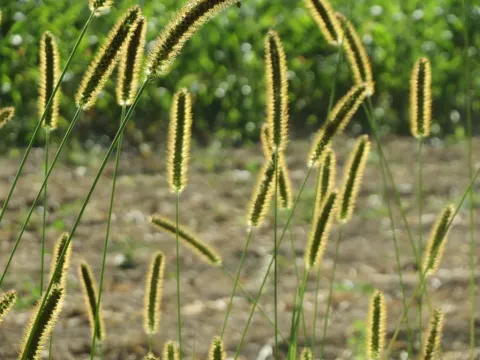
Foxtail millet
Setaria
Foxtail millet is a heat-loving crop, so it should be sown only after the soil has warmed up to 12–14 degrees Celsius at a depth of 10 centimeters. The optimal sowing time for most regions is late May to early June, once the danger of spring frosts has completely passed.
What the section contains
 Foxtail millet
Setaria italica (L.) P. Beauv.
Foxtail millet
Setaria italica (L.) P. Beauv. subsp. italica
Foxtail millet
Setaria italica (L.) P. Beauv.
Foxtail millet
Setaria italica (L.) P. Beauv. subsp. italica
 Giant foxtail
Setaria faberi R. A. W. Herrm.
Giant foxtail
Setaria faberi R. A. W. Herrm.
 Golden bristle grass
Setaria sphacelata (Schumach.) Stapf & C. E. Hubb. var. anceps (Stapf) Veldkamp
Golden bristle grass
Setaria sphacelata (Schumach.) Stapf & C. E. Hubb. var. anceps (Stapf) Veldkamp
 Green foxtail
Setaria viridis (L.) P. Beauv.
Green foxtail
Setaria viridis (L.) P. Beauv.
 Palmgrass
Setaria palmifolia (Koen.) Stapf
Palmgrass
Setaria palmifolia (Koen.) Stapf
 Setaria nigrirostris
 (Nees) Dur. et Schinz
Setaria nigrirostris
Setaria nigrirostris (Nees) Dur. et Schinz
 Setaria sphacelata
 (Schumach.) Stapf & C. E. Hubb.
Setaria sphacelata
Setaria sphacelata (Schumach.) Stapf & C. E. Hubb.
 Yellow foxtail
Setaria pumila (Poir.) Roem. & Schult.
Yellow foxtail
Setaria pumila (Poir.) Roem. & Schult.
 Yellow Paspalidium
Paspalidium flavidum (Retz.) A. Camus
Yellow Paspalidium
Paspalidium flavidum (Retz.) A. Camus
Foxtail millet
The sowing method depends on the cultivation purpose: row sowing with 15-centimeter spacing is used for green forage. For grain production, a wide-row method with 30–45 centimeter spacing is applied, allowing for effective inter-row cultivation and weed control.
Seeding rates depend on soil fertility and moisture levels: 12–16 kilograms per hectare are used for row sowing, and 6–8 kilograms for wide-row methods. Seeds should be planted at a shallow depth, no more than 2–3 centimeters, as they are small and lack the vigor for deep emergence.
Firming the soil after sowing is essential to ensure good contact between seeds and moist soil. In dry spring conditions, this step is critical for achieving uniform and rapid seedling emergence across the field.
After the seedlings appear, light harrowing during the tillering phase is recommended to control weeds. This significantly reduces competition at the start of the growth cycle, as the crop grows slowly and can be easily suppressed by vigorous weeds in the early stages.
Foxtail millet belongs to the Poaceae family and is highly demanding of heat and light throughout its vegetative period. It is a classic heat-resistant crop capable of maintaining efficient photosynthesis even under high temperature conditions.
The crop has moderate soil requirements but performs best on light sandy or fertile loamy soils. Saline and waterlogged sites are entirely unsuitable for industrial production of foxtail millet.
One of the crop's main features is its high drought resistance, making it indispensable in regions with high agricultural risk. Its root system can effectively extract moisture from deeper soil layers, maintaining growth during prolonged periods without rainfall.
The crop is extremely sensitive to temperature drops, so even short-term frosts can destroy the plants. Seedlings begin active growth only when stable warm weather arrives with daytime temperatures consistently above 20 degrees Celsius.
For high yields, foxtail millet requires good nitrogen fertilizer levels, applied during primary soil preparation. Phosphorus and potassium fertilizers promote stalk strength and increase lodging resistance, which is especially important in high-fertility soils.
The green mass yield of foxtail millet under proper agronomic management reaches 25–35 tons per hectare. In irrigated lands, these indicators can increase by 30–40 percent, making it a promising crop for securing forage supplies in dry areas.
When harvested for grain, the average yield ranges from 1.5 to 2.5 tons per hectare, depending on water availability. The grain of foxtail millet is valued for its high protein and starch content, making it an excellent concentrated feed for livestock.
Total yield depends heavily on rainfall frequency during critical development stages, particularly during the jointing phase. Using local varieties helps stabilize yields even in years with unfavorable weather conditions.
Experience from advanced farms shows that moderate use of organic fertilizers can increase hay yields by up to 50 percent. Hay quality remains high if the crop is harvested during the heading stage when panicles start to emerge.
The biological potential of foxtail millet allows for a second cut if weather conditions are favorable and moisture is sufficient. After the first cut, the crop regrows quickly, forming secondary vegetative mass suitable for grazing or haying.
The main diseases affecting foxtail millet are various types of smut that target the panicles. Pathogens can survive in the soil and on seeds, so pre-sowing seed treatment with fungicides is a mandatory agricultural practice.
In years with high humidity, crops may suffer from helminthosporiosis, which manifests as dark spots on the leaves. Systemic fungicides applied during the early stages of vegetation are effective in controlling these fungal infections.
Among pests, flea beetles are the most dangerous, attacking seedlings as soon as they emerge. A massive infestation can completely destroy crops across large areas, requiring immediate application of insecticides to protect the stand.
The frit fly also poses a threat, as its larvae damage the stems, causing deformation and stunted growth. Affected plants often fail to form panicles, leading to significant losses in potential grain yield.
Crop rotation plays a vital role in preventing the spread of pests and diseases. It is not recommended to sow foxtail millet after other cereal crops, as this encourages the accumulation of specific pathogens in the topsoil layer.
Harvesting foxtail millet for hay is performed during the heading stage, before the stems begin to harden. This is when the green mass contains the highest amount of nutrients, vitamins, and protein essential for quality animal feed.
For grain, harvesting begins when seeds reach full maturity and panicles take on their characteristic color. It is important to avoid delays, as the seeds are prone to shattering, which can lead to losses of up to 20 percent if harvest is postponed.
When using combine harvesters, either direct or windrow harvesting is employed. The windrow method is preferred in conditions of uneven ripening, as it allows grain to mature in the swath with minimal loss.
Collected grain requires thorough cleaning and drying to a moisture content of 13–14 percent before long-term storage. Failing to maintain proper temperature during drying can reduce the germination capacity of the seeds.
The straw remaining after threshing is often used as roughage for cattle or as animal bedding. It has acceptable nutritional value if the harvest was performed in a timely manner and without significant damage to the vegetative parts.