
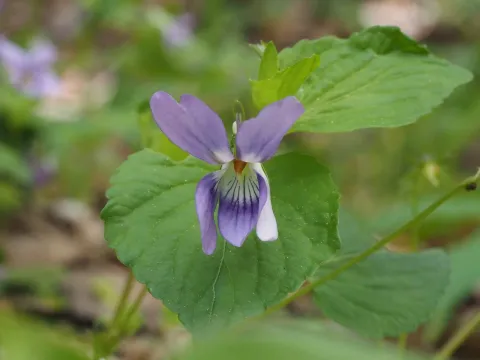
Kusano violet
Viola kusanoana
Sowing seeds of the Kusano violet in a nursery setting is usually carried out in the autumn, which ensures natural stratification of the seed material in the open ground.
What the section contains
Kusano violet
To accelerate seed germination, controlled greenhouse conditions can be used, maintaining a temperature range of 15–18 degrees Celsius after pre-chilling the seeds.
The planting depth of the seeds should be minimal, as the small seed material is sensitive to the thickness of the soil layer; therefore, light covering with substrate is optimal.
Sowing seeds in containers allows for better control of moisture and light for young seedlings, which is critical for the survival of this rare violet species.
Seedling transplanting is carried out upon the emergence of the first pair of true leaves, moving the plants into individual pots or prepared beds with organic-rich soil.
The Kusano violet belongs to the Violaceae family and is a perennial herbaceous plant that requires specific conditions for successful development.
The crop prefers semi-shaded areas with moderately moist, well-drained soil rich in humus and having a slightly acidic or neutral pH level.
The plant has a high requirement for uniform moisture of the substrate, while water stagnation at the roots is strictly unacceptable due to the risk of rot development.
The optimal temperature range for the vegetation of this species varies from 16 to 22 degrees Celsius, and the plant is capable of tolerating moderate winter temperature drops.
In its natural habitat, the crop is adapted to forest litter conditions, which must be taken into account when choosing a planting site in a garden or greenhouse.
The most common disease for this species in dense plantings is powdery mildew, which manifests as a white coating on the leaves.
In conditions of excessive humidity, the violet is susceptible to grey mold (Botrytis), which can rapidly destroy the entire aerial part of the plant in a short time.
Among pests, aphids and spider mites pose the greatest threat to ornamental value, feeding on the juices of young leaves and flower stalks in dry weather.
Slugs and snails can cause serious mechanical damage to the foliage, so regular inspection and the installation of protective barriers are recommended when tending the plantings.
- Timely removal of affected plant parts.
- Regular ventilation of plantings to reduce humidity.
- Treatment with biological fungicides for preventive purposes.
The economic use of the Kusano violet is primarily limited to ornamental floriculture; therefore, a traditional harvest for this crop is not performed.
In the case of seed production, capsules are collected after they turn brown but before natural opening to prevent self-sowing and loss of material.
Collected seeds are thoroughly dried in a dark, ventilated place, then cleaned of perianth remains and stored in paper bags in a cool location.
When harvesting the aerial part for herbarium or research purposes, work is conducted in dry weather, cutting the shoots at the base with a sharp tool.
It is important to leave part of the root system untouched to ensure vegetative regrowth of the plant for the following season in perennial cultivation.