
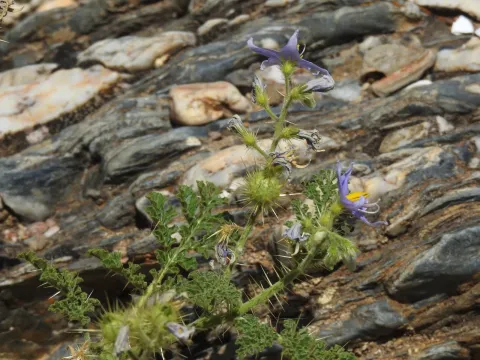
Watermelon-leaf nightshade
Solanum citrullifolium
Watermelon-leaf nightshade, taxonomically classified as Solanum citrullifolium, is a member of the Solanaceae family. It is indigenous to the arid regions of the southwestern United States and northern Mexico, functioning primarily as a wild relative of cultivated Solanum crops.
What the section contains
Watermelon-leaf nightshade
The plant thrives in well-drained, sandy, or gravelly soils that mirror its native habitat. Proper soil aeration is critical, as the species is highly susceptible to root rot if water is permitted to accumulate around the root collar.
Climatically, this species is adapted to intense sunlight and high heat. It does not require significant rainfall and exhibits remarkable resilience to drought conditions, maintaining physiological integrity through deep root penetration.
Cultivation practices for this species focus on site selection that guarantees high solar radiation exposure. Nitrogen levels should be kept low to moderate to avoid excessive vegetative growth that may distract from the plant's reproductive vigor.
Botanically, it is distinct due to its prickly stems and foliage that closely mimic the leaf morphology of a watermelon. The flowers are typically violet with a yellow central stamen, characteristic of many desert-adapted Solanum species.
The most prominent pest affecting Solanum citrullifolium is the Colorado potato beetle. Given its relationship to other nightshade crops, this pest can cause significant defoliation if left unmanaged during the early summer months.
Spider mites pose a significant threat during periods of extreme aridity. They congregate on the undersides of leaves, and their feeding activity can quickly lead to widespread chlorosis and plant stunting if not treated with systemic interventions.
Fungal pathogens such as Alternaria species may infect the plant under conditions of poor airflow or high humidity. Maintaining adequate spacing between individual plants is the most effective cultural method for preventing disease spread.
Viral pathogens, specifically those causing mosaic or leaf-curl symptoms, represent a threat that can compromise the plant's genetics. Control of insect vectors like whiteflies and aphids is essential for maintaining the health of the population.
Soil-borne pathogens, including various species of nematodes, can weaken the root system. Crop rotation and the use of solarized soil are recommended strategies for minimizing the presence of these harmful microorganisms in the root zone.