
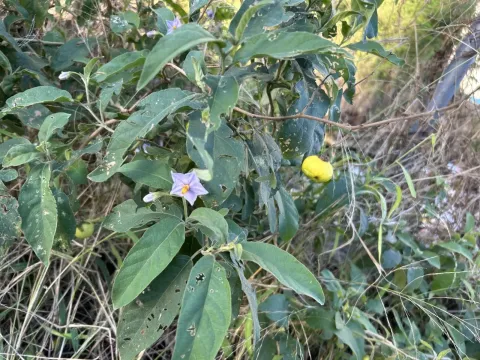
Solanum campylacanthum
Solanum campylacanthum
Solanum campylacanthum is a perennial shrub belonging to the Solanaceae family. It is recognized for its characteristic spiny stems and is traditionally grown in tropical and subtropical climates, particularly in parts of East and Southern Africa.
What the section contains
Solanum campylacanthum
Sowing should take place in well-prepared seedbeds during the onset of the warm season. Seeds are typically sown at a depth of about 1–2 cm, ensuring the soil remains consistently moist until germination occurs, which usually takes 10 to 14 days.
Given its perennial nature, the spacing must allow for substantial plant growth, typically 1 meter between plants and 1.5 meters between rows. This ensures adequate space for canopy development and essential agricultural field operations.
When starting seeds indoors, a sterile potting mix is recommended to prevent seedling damp-off. Acclimatization is necessary before transplanting to an outdoor environment to ensure the plants can handle external conditions.
The plant demonstrates good vigor once established. Regular pruning is often required to maintain the desired plant architecture and to remove older, woody stems that may reduce fruit production over time.
The crop thrives in full sunlight, requiring at least 6–8 hours of direct exposure daily. Insufficient light leads to etiolation, making the stems weak and prone to breaking under the weight of the developing fruits.
Soil requirements focus on high organic matter content and excellent drainage. While the plant is somewhat drought-tolerant, its yield potential is significantly higher when soil moisture is managed through irrigation during dry spells.
Temperature management is vital, as the plant is extremely sensitive to frost. Optimal growth occurs between 20°C and 30°C. In regions where temperatures dip near freezing, plants must be protected or grown in controlled environments.
Nutrient management involves balanced fertilization. Nitrogen promotes vegetative growth, while phosphorus and potassium are essential during the flowering and fruit-setting stages to ensure high-quality produce.
Aeration of the soil is important; thus, periodic mechanical hoeing or cultivation around the base of the plant is recommended to improve gas exchange in the root zone and suppress unwanted weeds.
The crop is vulnerable to typical Solanaceae pests, including aphids and various species of leaf-eating beetles. Early detection through regular field scouting is critical to preventing large-scale infestation.
Fungal pathogens such as Phytophthora are significant threats in high-humidity zones. These diseases can lead to rapid decay of foliage and stems, requiring immediate action, such as the application of preventative fungicides.
Spider mites are common in drier climates, causing yellowing and shedding of leaves. If left untreated, severe infestations can significantly reduce the photosynthetic capacity of the plant, leading to poor yields.
Integrated Pest Management (IPM) is the most sustainable approach for this crop. This involves crop rotation, the use of biological control agents, and precise, scheduled chemical applications when threshold levels are reached.
- Monitoring for pest presence on the undersides of leaves
- Removal and disposal of infected plant material
- Maintaining adequate spacing to improve air circulation