
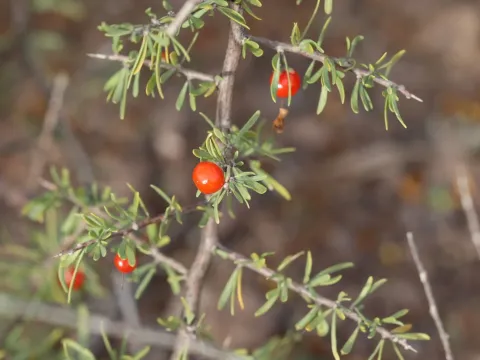
Berlandier wolfberry
Lycium berlandieri
Berlandier wolfberry (Lycium berlandieri) is a perennial shrub belonging to the Solanaceae family. This species is closely related to common boxthorn and is well-adapted to the harsh conditions of semi-arid ecosystems and dry climates.
What the section contains
Berlandier wolfberry
In its natural habitat, the plant is native to the southwestern United States and northern Mexico. It thrives in well-drained, sandy, or rocky soils, demonstrating remarkable tolerance to salinity and low soil nutrient availability compared to other crops.
For optimal development, the culture requires high levels of solar radiation and survives on minimal annual precipitation. Berlandier wolfberry is exceptionally drought-tolerant and can persist through prolonged dry spells, making it a viable candidate for land rehabilitation projects.
Botanically, it appears as a densely branched shrub featuring small, alternate leaves and the characteristic spines of the Lycium genus. The flowers are funnel-shaped, typically ranging from white to pink or violet, and the fruit consists of small, red, juicy berries.
The agricultural and economic utility of the crop includes its potential as a source of antioxidants and as a food supply for native wildlife. It is frequently employed in xeriscaping and landscape design to create impenetrable, functional living fences.
The primary threats to Berlandier wolfberry include viral diseases common to the Solanaceae family, typically transmitted by insect vectors. These pathogens, such as mosaic viruses, can cause significant leaf deformation and reduce the overall vigor of the shrub.
Under conditions of excessive moisture, the root system may become susceptible to fungal infections, such as Fusarium wilt. Proper soil aeration and meticulous water management are essential practices to prevent the development of such conditions in commercial plantings.
Among pests, various beetles pose the greatest risk by feeding on the plant's succulent foliage. Additionally, spider mite outbreaks can occur during periods of extreme heat and low atmospheric humidity, requiring regular monitoring of the foliage to prevent damage.
The plant possesses a high capacity for regeneration, meaning that pest damage rarely leads to total plant mortality. However, to maintain the quality of the berries and the aesthetic value of the shrub hedges, proactive phytosanitary measures are recommended.
Biological pest control is the preferred strategy since the berries are often consumed by humans or livestock. Implementing eco-friendly biological agents helps to mitigate chemical runoff and supports sustainable farming practices for this resilient species.