
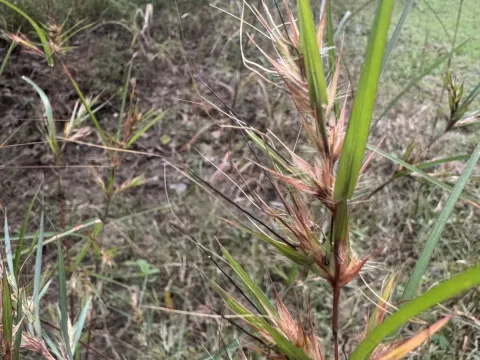
Themeda quadrivalvis
Themeda quadrivalvis
The planting of Themeda quadrivalvis must be aligned with the onset of the rainy season, as the seeds require sufficient moisture to initiate germination.
What the section contains
Themeda quadrivalvis
Optimal sowing temperatures range between 20 and 30 degrees Celsius, ensuring rapid seedling establishment and reducing the risk of early-stage mortality.
Seeds should be broadcast or sown in rows with spacing of 30 to 50 centimeters to ensure adequate space for each plant to develop its root system.
Because the seeds are relatively small, they should be planted at a shallow depth of approximately 1 to 2 centimeters to avoid emergence failure.
In large-scale production, mechanical seed drills are used to ensure uniform distribution and proper depth, which significantly improves the final stand density.
Themeda quadrivalvis belongs to the Poaceae family and is recognized as a hardy perennial grass native to tropical and subtropical regions of the world.
The plant exhibits remarkable adaptability to diverse soil types, although it thrives best on well-drained loamy soils with slightly acidic to neutral pH.
It is highly drought-tolerant, possessing physiological mechanisms that allow it to survive prolonged dry spells that would be fatal to other forage species.
Full sunlight is a critical requirement for this species; therefore, planting sites should be selected to avoid shading from trees or larger neighboring crops.
The plant is sensitive to waterlogging; therefore, sites with good drainage and minimal risk of seasonal flooding are preferred for commercial cultivation.
The forage yield of this grass species is highly influenced by soil fertility and the frequency of grazing or cutting during the active growing season.
With proper management, including nitrogen fertilization during the peak vegetative phase, the grass can produce significant biomass yields annually.
Nutritional value peaks during the early growth stages, making it an excellent source of protein and essential minerals for livestock when managed correctly.
Total dry matter yield is dependent on the stand age and climate conditions, with higher yields usually observed in regions with consistent summer rainfall.
Monitoring the plant density and health allows farmers to adjust grazing pressure, ensuring consistent output throughout the agricultural season.
While generally robust, Themeda quadrivalvis can be affected by fungal pathogens that thrive under high-humidity conditions, such as leaf spot or rust diseases.
Pest pressures include various sucking insects, such as aphids and leafhoppers, which can weaken the plant and serve as vectors for viral infections.
Weed competition during the establishment phase is a significant threat; young seedlings must be protected from aggressive grasses that might shade them out.
Overgrazing poses a major threat to stand longevity, as it depletes the root reserves of the plant and leaves the soil vulnerable to erosion.
Integrated pest management strategies are recommended, focusing on maintaining plant vigor through appropriate fertilization and avoiding over-stocking.
The optimal time for harvesting as hay is during the pre-flowering stage, when the nutrient content is at its highest and stems have not yet lignified.
Grazing management should follow a rotational system, allowing the grass adequate recovery time after each period of intensive livestock utilization.
During mechanical harvesting, the cutter bar should be set to a height that preserves the basal buds, ensuring the plant can regenerate quickly.
For seed production, harvesting should be timed carefully when the seed heads show signs of turning color to maximize yield and prevent seed shattering.
Storage of harvested material requires dry, well-ventilated conditions to prevent mold formation and maintain the palatability of the forage for livestock.