
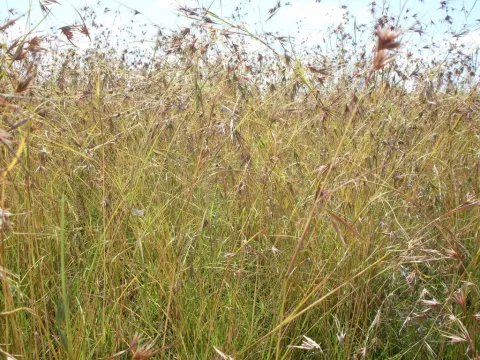
Themeda
Themeda
Themeda is a perennial grass species that is typically sown in the spring when soil temperatures reach 15-18 degrees Celsius. To ensure uniform germination, seeds should be sown at a shallow depth of no more than 2-3 centimeters into well-prepared, friable soil.
What the section contains

Themeda
While often self-seeding in natural environments, when introduced as a managed crop, it is recommended to use stratified seeds to improve success rates. Since the germination pace is moderate, seedlings must be protected from weed competition during the critical early stages of development.
Seeding rates should be adjusted based on seed purity and viability, averaging between 8 to 12 kilograms per hectare. Proper plant density is essential for establishing a robust sod layer that effectively protects the soil from erosion.
Post-sowing, it is beneficial to roll the field to ensure optimal soil-to-seed contact and improve moisture retention. In arid regions, timing the sowing immediately after rainfall is crucial to provide the seeds with the necessary moisture for successful establishment.
In subsequent years, Themeda exhibits a strong ability to regenerate from rhizomes, which allows for sustained productivity over several years without the need for constant re-seeding.
Belonging to the Poaceae family, Themeda is well-adapted to tropical and subtropical climates. It thrives in sunny locations and shows poor performance in shaded areas, where vegetative growth is significantly reduced.
The plant has moderate soil requirements but achieves best performance in well-drained loamy soils. It is known for its ability to tolerate temporary water deficits due to a deep, extensive root system that accesses moisture from lower soil profiles.
The species grows successfully across a wide range of soil acidity levels, with an optimal pH range between 5.5 and 7.0. Waterlogged soil significantly hinders development, highlighting the necessity of proper field drainage.
Temperature is a key factor: as a warm-season grass, Themeda ceases active growth when temperatures drop below 10 degrees Celsius. In areas with frost, the above-ground biomass dies back, but the root system remains viable until the following season.
Applying mineral fertilizers, particularly nitrogen, promotes vigorous tillering and increases total green mass yield. Split fertilizer applications are recommended to maintain steady growth throughout the entire vegetative period.
The yield of Themeda green mass depends heavily on management practices and the level of agricultural input. Under optimal growing conditions, the crop can provide multiple cuts per season, ensuring high pasture productivity.
On average, under extensive management, the yield ranges from 3 to 6 tons of dry matter per hectare. Intensive cultivation techniques, including irrigation and targeted fertilization, can double these productivity figures.
The agricultural value of Themeda is diverse; it is highly valued as a forage crop for grazing livestock, especially in regions where other grasses fail during dry seasons. When harvested at a young stage, it offers excellent nutritional value and palatability.
Beyond forage, the plant plays a vital role in land restoration and erosion control. Its dense root system binds the soil effectively, protecting against wind and water erosion of the topsoil layer.
- High drought tolerance ensures consistent performance.
- Strong regrowth capacity allows for multiple harvest cycles.
- Rapid sod formation protects soil structure against degradation.
The primary threats to Themeda crops are fungal diseases that proliferate in high-humidity conditions. Rusts and various leaf spots can significantly diminish forage quality if preventive management is not implemented.
Among pests, subterranean larvae that feed on roots and various sap-sucking insects that damage foliage pose the greatest risk. Regular monitoring of pest populations is advised, especially during extended warm weather periods.
Weed interference is a major challenge during the establishment phase. It is necessary to employ both cultural methods, such as timely mowing, and chemical control options when weed density becomes prohibitive.
Improper grazing management is another major threat: excessive grazing pressure leads to stand thinning and the depletion of carbohydrate reserves in the roots. Rotational grazing is essential for maintaining crop health.
Disease prevention relies on maintaining good agronomic practices, ensuring adequate drainage, and avoiding excessively high stand density. Utilizing varieties resistant to local pathogens is the most effective long-term defense strategy.
Harvesting for hay or silage should occur during the heading stage, when the nutritional content of the plant is at its peak. Delaying harvest leads to increased fiber content and a significant reduction in feed digestibility.
For grazing purposes, an optimal management regime keeps the sward height at 20-30 centimeters. This provides the best balance between available biomass and the speed of subsequent plant recovery.
When making hay, rapid drying is critical to preserve the vitamin content and color of the grass. The use of tedders helps distribute moisture evenly and prevents decay in the lower layers of the windrow.
Seed harvesting should be timed for full maturity, which is visually indicated by a change in inflorescence color. Specialized equipment that minimizes shattering losses is necessary, as Themeda seeds tend to drop easily upon maturity.
Proper storage of harvested hay is essential and should take place in ventilated structures or under shelters that prevent contact with rain. Adherence to storage guidelines prevents mold growth and feed spoilage.