
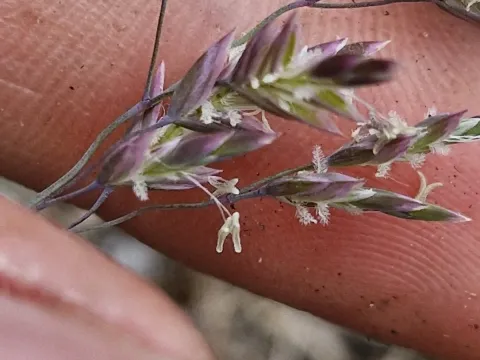
Blue tussock
Poa colensoi
Blue tussock (Poa colensoi) is a perennial grass species belonging to the Poaceae family. Native to New Zealand, this species is well-adapted to high-altitude environments and subalpine grassland ecosystems, showing remarkable resilience to harsh conditions.
What the section contains
Blue tussock
The crop is highly valued for its cold tolerance and adaptability to nutrient-poor soils. It grows in dense tussocks, which provide excellent soil cover and protect the plant's heart from extreme wind and temperature fluctuations during the dormant season.
Botanically, it features narrow, rigid, and often bluish-green leaves that form compact clumps. Its root system is fibrous and deep, allowing the plant to stabilize soil particles effectively on steep terrains, which is a major advantage for land conservation.
Regarding cultivation requirements, the species prefers well-drained soils and thrives in open, sunny locations. While it exhibits moderate drought tolerance once established, consistent soil moisture during the active growth phase is critical for achieving optimal biomass production.
In terms of agricultural use, Blue tussock is primarily utilized as a forage grass in extensive grazing systems. Its ability to maintain structural integrity under grazing pressure makes it a reliable component for permanent pastures in cool-climate regions.
The primary threats to this grass include fungal pathogens such as rusts and mildews, which can affect the foliage during periods of prolonged humidity. Maintaining good air circulation within the stand is essential to prevent these diseases.
Pests such as grass grubs and various larvae can damage the roots and basal stems, particularly in younger stands. Monitoring and early intervention are necessary to ensure the stand remains dense and productive throughout its lifespan.
Soil compaction represents a significant abiotic threat that restricts root development and nutrient uptake. Avoiding overgrazing during wet weather is a standard management practice to protect soil structure and prevent degradation of the grass population.
Competition from invasive species can hinder the establishment of Blue tussock in the early stages. Effective site preparation and selective weeding help the crop gain dominance and establish a stable, long-lasting canopy that suppresses potential weeds.
Climate-related stressors, including extreme heat waves or unseasonable frosts, may temporarily reduce growth rates. However, due to its evolution in rigorous mountain environments, the species recovers quickly once environmental conditions normalize.