
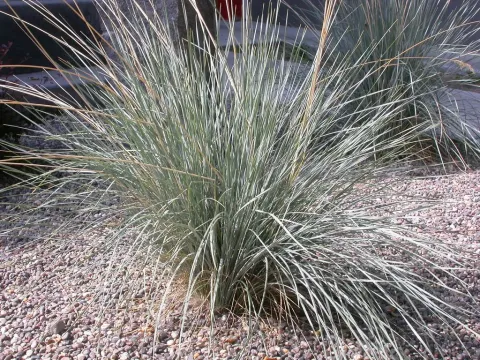
Blue oat grass
Helictotrichon sempervirens
Blue oat grass (Helictotrichon sempervirens) is a perennial ornamental grass belonging to the Poaceae family. Originating from the Mediterranean region and parts of Central Europe, this plant is well-adapted to rocky habitats, arid slopes, and sunny, exposed environments.
What the section contains
Blue oat grass
The plant is prized for its evergreen, steel-blue, rigid foliage that forms a neat, dense clump. In early summer, it produces tall, slender, wheat-like flower spikes that emerge with a golden-beige tint and persist into autumn, providing visual interest even as they dry in the late season.
Regarding environmental requirements, Blue oat grass demands full sun exposure to maintain its characteristic intense blue coloration. In shaded conditions, the plant tends to turn green and lose its compact habit, often becoming susceptible to structural instability and disease.
Soil conditions are critical for the health of this species. It thrives in well-drained, sandy, or rocky soils with moderate fertility. It is highly intolerant of heavy, wet, or waterlogged clay soils, which can lead to rapid root rot and the death of the clump during dormant seasons.
Management practices are relatively simple, focusing on minimal fertilization and periodic maintenance. Each spring, the gardener should rake out dead foliage to encourage new growth. It is important to avoid over-watering, as this grass is exceptionally drought-tolerant once established.
The primary threat to Helictotrichon sempervirens is improper moisture management, which often leads to root rot. Poor drainage coupled with high humidity during winter or rainy periods is the most common cause of plant failure in cultivated environments.
Leaf rust is an occasional fungal issue that may occur if the plants are placed in areas with insufficient airflow or high humidity. Maintaining adequate spacing between specimens helps mitigate this risk by allowing foliage to dry out quickly after rainfall.
In terms of insect pests, aphids and spider mites can occasionally affect the grass, especially during hot, dry spells. These pests weaken the plant by feeding on its sap, which may cause yellowing or browning of the leaf tips if left untreated.
Integrated pest management suggests that small infestations can be controlled by simply washing the foliage with a strong stream of water. For more severe cases, targeted horticultural oils or insecticidal soaps can be applied as a safer alternative to heavy chemical treatments.
Overall, providing an environment that mimics its natural habitat—sunny and well-drained—is the best defense against pests and diseases. When properly sited, Blue oat grass is a robust, low-maintenance choice that rarely requires intensive chemical interventions.