
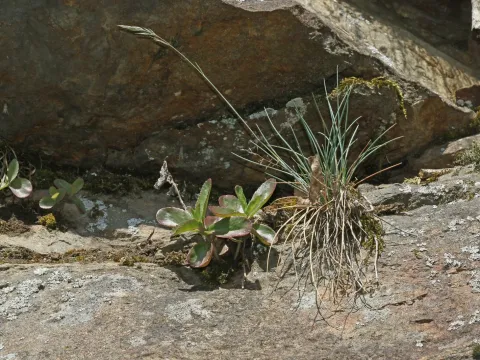
Pale fescue
Festuca pallens
Pale fescue (Festuca pallens) is a perennial grass belonging to the Poaceae family. It is a highly resilient species known for its ability to thrive in harsh, dry environments where other grasses struggle to survive.
What the section contains
Pale fescue
The plant is naturally adapted to rocky, sandy, and calcareous soils. Its biology is centered around xeric conditions, making it an excellent candidate for regions with low rainfall and nutrient-poor substrates.
One of the key features of this grass is its deep and expansive root system. This allows the plant to access moisture deep underground and provides superior stability to soil, preventing erosion on slopes and banks.
Pale fescue requires full sunlight for optimal growth. It is highly resistant to temperature fluctuations, showing great cold tolerance during winter months and maintaining vigor throughout hot, dry summers.
The plant creates a dense, tussock-like growth habit. This structure not only protects the soil surface but also limits the space for invasive weed species, effectively outcompeting them over time once established.
Seeding of Festuca pallens is typically carried out in early spring or autumn. These periods provide the necessary moisture levels to support germination and the establishment of the initial root architecture.
The seeds should be sown at a shallow depth of approximately 1 cm. Placing seeds too deep into the soil can prevent them from reaching the surface, as the energy reserves in the seeds are quite limited.
Preparing a clean, weed-free seedbed is essential for successful cultivation. Given the slow growth rate of young plants, minimizing competition during the first year is critical for long-term field success.
Seeding rates should be adjusted based on the specific application. For erosion control, higher rates are often used to ensure rapid ground coverage and soil stabilization in the shortest possible time.
Firming the soil after sowing using a roller is a recommended practice. This increases the contact between the seeds and the soil, enhancing capillary water uptake and ensuring a higher overall germination rate.
While primarily used for soil protection and landscaping, Pale fescue also offers moderate nutritional value for grazing animals. Its yield is not comparable to intensive forage crops but remains stable under harsh conditions.
In managed systems, biomass production peaks during the spring and early summer. The regrowth after cutting is relatively slow, reflecting the plant's strategy of investing in root development rather than rapid foliage turnover.
The yield quality remains consistent even in dry years, providing a reliable source of green matter when other, less hardy forage species might fail or go dormant due to heat stress.
Harvesting for seed production requires careful timing. The seeds must be allowed to ripen fully on the stem, and harvesting should be done when moisture content is low to prevent storage issues.
Yield management focuses on sustaining the density of the stand rather than maximizing biomass. Overgrazing should be strictly avoided to ensure the plants maintain their vigor and root health.
Pale fescue is remarkably hardy and rarely faces significant health issues. Its natural environment often suppresses the development of many common agricultural pests and diseases.
In poorly drained areas, the plant may become susceptible to crown rot or various fungal infections. Maintaining good soil drainage is the most effective way to prevent these issues.
Occasional infestations of grass-feeding insects can occur, but these are rarely economically significant unless the stand is already stressed by drought or poor nutrient management.
Effective management includes regular inspection for signs of fungal spots or abnormal yellowing. Early detection allows for corrective measures, such as adjusting irrigation or thinning the stand.
- Ensuring high airflow through the canopy to prevent humidity buildup.
- Using certified, disease-free seed for initial establishment.
- Avoiding over-fertilization which can make plants more attractive to pests.
- Implementing controlled grazing or mowing to maintain stand health.