
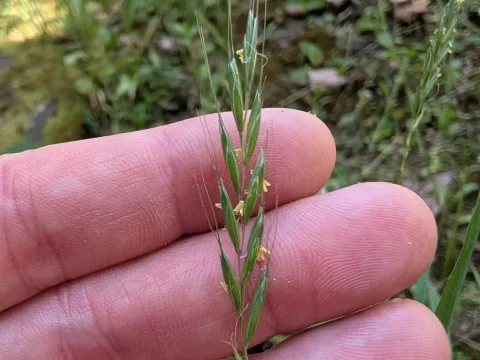
Bearded couch
Elymus caninus
Bearded couch is a perennial cool-season grass, and the best time for establishment is late summer or early autumn to ensure plants have enough time to develop roots before winter.
What the section contains
Bearded couch
Spring sowing is also viable if done early, allowing seeds to take advantage of soil moisture; however, seeds should be sown shallowly to ensure rapid emergence.
Seed placement should be at a depth of 2 to 4 centimeters, depending on the soil texture, with higher depths used in light sandy soils.
The seeding rate typically ranges from 10 to 15 kilograms per hectare, depending on the desired density and the germination capacity of the seed lot.
Early stage weed management is critical, as bearded couch seedlings grow relatively slowly and are easily outcompeted by aggressive annual weeds.
Belonging to the Poaceae family, Elymus caninus is well-adapted to temperate climates, thriving in cool, moist environmental conditions across its native range.
It prefers fertile, loamy soils with good drainage but can tolerate a wider range of soil types, provided they do not experience prolonged waterlogging.
This grass is notable for its shade tolerance, allowing it to grow successfully in open woodlands, forest edges, and shaded pastures where other species fail.
It requires moderate soil fertility and performs best in neutral to slightly acidic soil conditions, showing a good response to organic matter content.
Native to Eurasia, the species is highly resilient and naturally occurs in various plant communities, proving its ability to withstand different ecological stressors.
Bearded couch is primarily utilized for hay production and grazing, providing a reliable source of green forage that is highly palatable to livestock.
When managed under intensive cutting regimes and provided with sufficient nitrogen fertilization, it can produce a substantial yield of high-quality biomass.
The plant demonstrates excellent regrowth capabilities after being cut or grazed, making it a valuable species for intensive grassland management systems.
Its deep root system helps in soil stabilization, contributing to land restoration efforts and preventing soil erosion on sloped agricultural fields.
As a forage crop, it is often included in seed mixtures to improve the overall diversity and nutritional profile of perennial pastures and meadow lands.
The crop is susceptible to various fungal pathogens, most notably leaf rust, which tends to proliferate in high-humidity environments during the growing season.
Powdery mildew can also affect the foliage, particularly in dense stands where airflow is restricted, leading to reduced photosynthetic efficiency.
Agricultural pests, such as aphids and various cereal beetles, may feed on the stems and leaves, potentially causing stunted growth in young crops.
Root-feeding nematodes can become a significant issue, weakening the plant's ability to absorb water and nutrients, especially in sandy or light soils.
Integrated pest management strategies, including crop rotation and the maintenance of vigorous plant health, are essential to minimize the impact of these threats.
For hay production, the optimal harvest timing is during the late booting stage or the onset of flowering to maximize nutritional quality and digestibility.
Delayed harvesting leads to a decline in protein content and an increase in fiber, which significantly reduces the quality of the harvested hay product.
Seed harvest is conducted when the spikes are fully mature, requiring precise machine calibration to ensure high seed recovery and minimal shattering.
Post-harvest processing involves thorough cleaning and drying of the seeds to prevent moisture-related storage issues such as fungal mold or seed spoilage.
Proper storage in cool, dry conditions is necessary to maintain the seed's viability and vigor until the next planting cycle begins in the following season.