
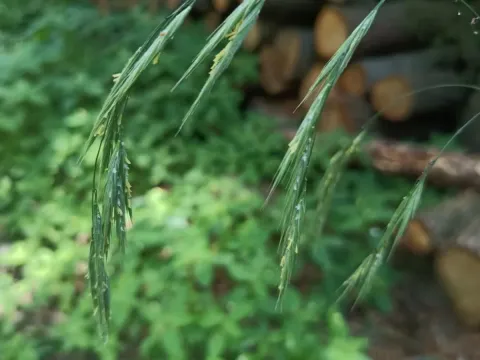
Beneken's brome
Bromus benekenii
Beneken's brome (Bromus benekenii) is a perennial grass belonging to the Poaceae family. Sowing is typically conducted in early spring as soon as soil temperatures reach 8–10 degrees Celsius, or in late summer to allow for root establishment before winter.
What the section contains
Beneken's brome
For a uniform sward, seeds should be sown at a row spacing of 15–20 cm with a planting depth of 2–3 cm. It is essential to firm the soil after sowing to ensure optimal moisture contact and germination.
The seeding rate for Beneken's brome generally ranges from 12 to 16 kg per hectare, depending on the purity of the seed material and the intended density of the future stand.
Because the grass exhibits a slow growth rate during its first year, it requires vigilant weed management to ensure that young seedlings are not outcompeted by aggressive weeds.
Once established, the grass develops a robust rhizomatous root system, which helps it form a dense, persistent sod that effectively suppresses weed growth in subsequent years.
Beneken's brome is a woodland and forest-steppe species that thrives in fertile, well-moistened soils. It is notably shade-tolerant, making it well-adapted to forest edges and shrubland areas.
The crop demands high soil fertility, preferring loamy soils with a deep humus layer and a neutral or slightly acidic pH level for optimal development.
While the plant shows moderate tolerance to temporary moisture excess, it does not tolerate long-term waterlogging, thus requiring well-drained fields to prevent root decay.
The optimal temperature range for active growth is 18–22 degrees Celsius, and the species is characterized by high cold resistance, ensuring survival throughout harsh winter conditions.
In agricultural settings, the application of mineral fertilizers, particularly nitrogen-based ones, significantly boosts vegetative growth and overall hay yield during the growing season.
The agricultural productivity of Beneken's brome is noted for its high-quality biomass, which is rich in essential nutrients and highly palatable for livestock.
Depending on the management and moisture levels, the yield of green mass typically reaches 150–200 decitonnes per hectare over two cuts within a single season.
The hay produced from this grass is highly valued for its softness and high leaf-to-stem ratio, making it a superior choice compared to some other coarser grass species.
When cultivated for seed production, yields typically range from 3 to 5 decitonnes per hectare, requiring careful monitoring to avoid premature seed shattering.
Maximum stand productivity is usually achieved between the third and fifth years, after which maintenance operations or supplementary fertilization are recommended to sustain output.
Beneken's brome can be susceptible to fungal diseases such as powdery mildew, particularly when crop stands are overly dense or during periods of prolonged humidity.
Under high-moisture conditions, leaf rust may occur, which adversely affects the photosynthetic capacity of the plants and lowers the overall forage quality and mass.
Primary pests include cereal flies and aphids, which may damage young shoots during the tillering stage and stunt the development of the stand.
Overgrazing poses a risk to the integrity of the rhizome system; therefore, managing grazing pressure is crucial to prevent stand thinning and long-term degradation.
Effective management strategies, including the use of balanced crop rotation and timely weed control, are essential to mitigate risks associated with pests and diseases.
The optimal time for harvesting Beneken's brome for hay is during the early flowering phase, when the accumulation of nutrients is at its peak before stems become excessively lignified.
For silage or haylage production, harvesting should be performed slightly earlier in the season to maintain maximum protein and sugar content in the forage.
A cutting height of at least 5–7 cm is recommended to ensure the plant's ability to regrow efficiently and maintain a healthy stand for future harvests.
Harvesting processes should utilize tedding equipment to ensure uniform drying of the biomass, which is crucial for preserving nutritional value and preventing spoilage.
Modern mechanized harvesting methods enable quick operations, which is vital for securing high-quality forage and minimizing yield losses in the field.