
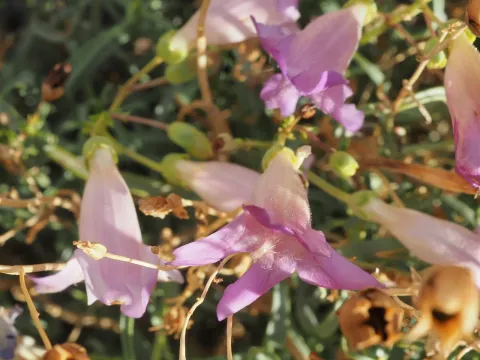
Penstemon
Penstemon Schmidel.
Sowing times for Penstemon depend on the chosen propagation method. Seeds are usually sown indoors in late February or March in a light, loose substrate.
What the section contains
 Beardlip penstemon
Penstemon barbatus (Cav.) Roth
Beardlip penstemon
Penstemon barbatus (Cav.) Roth
 Desert beardtongue
Penstemon superbus A. Nelson
Desert beardtongue
Penstemon superbus A. Nelson
 Foothill penstemon
Penstemon heterophyllus Lindl.
Foothill penstemon
Penstemon heterophyllus Lindl.
 Foxglove beardtongue
Penstemon digitalis Nutt. ex Sims
Foxglove beardtongue
Penstemon digitalis Nutt. ex Sims
 Hairy beardtongue
Penstemon hirsutus (L.) Willd.
Hairy beardtongue
Penstemon hirsutus (L.) Willd.
 Hybrid Penstemon (P. palmeri, P. parryi, and P. superbus crosses)
Hybrids between Penstemon palmeri and Penstemon parryi and Penstemon superbus
Hybrid Penstemon (P. palmeri, P. parryi, and P. superbus crosses)
Hybrids between Penstemon palmeri and Penstemon parryi and Penstemon superbus
 Palmer penstemon
Penstemon palmeri A. Gray
Palmer penstemon
Penstemon palmeri A. Gray
 Parry's penstemon
Penstemon parryi (A. Gray) A. Gray
Penstemon barbatus x Penstemon heterophyllus
Penstemon barbatus x Penstemon heterophyllus
Parry's penstemon
Penstemon parryi (A. Gray) A. Gray
Penstemon barbatus x Penstemon heterophyllus
Penstemon barbatus x Penstemon heterophyllus
 Penstemon bradburyi
 Pursh
Penstemon bradburyi
Penstemon bradburyi Pursh
 Penstemon hartwegii
 Benth.
Penstemon hartwegii
Penstemon hartwegii Benth.
 Penstemon Hybrids
Penstemon Hybrids
Penstemon Hybrids
 Rock penstemon
Penstemon rupicola (Piper) Howell
Rock penstemon
Penstemon rupicola (Piper) Howell
 Smooth beardtongue
Penstemon laevigatus Aiton.
Smooth beardtongue
Penstemon laevigatus Aiton.
Penstemon
Seeds often require stratification at temperatures between 0 and +5 degrees Celsius for about a month to ensure successful and uniform germination.
Seedlings should be transplanted into the open ground only after the risk of frost has passed, typically in late May or early June in temperate zones.
Autumn sowing directly into the soil is also possible if local winter conditions are mild enough for young plants to survive under protective mulch.
Vegetative propagation via cuttings is best performed during the summer, using shaded beds and a well-draining rooting medium for the best results.
Penstemon belongs to the Plantaginaceae family and consists of perennial herbs or subshrubs native primarily to North America.
The crop requires open, sunny locations protected from strong winds that might damage the tall, slender stems characteristic of many cultivars.
Well-drained soil is essential, as waterlogged conditions during winter are the primary cause of plant failure, leading to root rot and crown damage.
Plants prefer neutral to slightly acidic sandy-loam soils rich in organic matter, with added grit or sand to promote oxygen circulation around the roots.
While regular watering is necessary during active growth, it is crucial to avoid overhead irrigation during flowering to preserve the quality of the blossoms.
Fungal diseases related to high soil moisture, such as powdery mildew and various types of root or crown rot, are the most significant threats to Penstemon.
Heavy, clay-based soils that retain too much water are prone to fostering pathogenic fungi, which can quickly devastate a well-established planting.
Common pests include thrips and nematodes, which feed on plant sap and can severely weaken the health of the specimens, making them vulnerable to secondary infections.
Proactive disease management involves proper spacing for airflow, disciplined watering schedules, and regular weeding to prevent microclimate issues around the plants.
In cases of confirmed fungal infection, the application of systemic fungicides is recommended to halt the spread and protect neighboring healthy plants.
Penstemon is primarily utilized in ornamental landscaping and cut-flower production, prized for its diverse tubular blooms and long-lasting display.
Deadheading spent flowers is a crucial maintenance practice that encourages subsequent blooming cycles in many Penstemon species throughout the summer season.
Seed collection occurs when the capsules turn brown and begin to dry; they should be harvested carefully and dried in a well-ventilated area before cleaning.
Winter preparation includes light pruning of the foliage, although leaving some growth can help trap snow, providing natural insulation against extreme cold.
Mulching the root zone with straw or horticultural fleece is highly recommended in colder climates to prevent deep freezing of the crown and root system.