
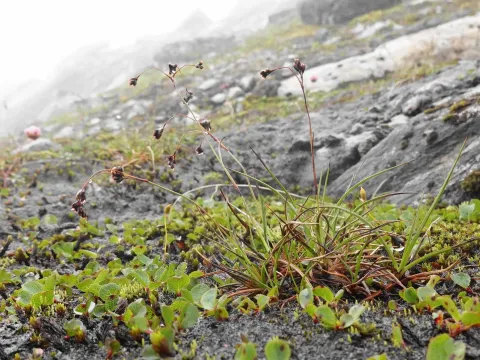
Curved woodrush
Luzula arcuata
Curved woodrush (Luzula arcuata) is a perennial herbaceous plant belonging to the Juncaceae family. While not a conventional agricultural crop, it represents a vital botanical element in high-latitude ecosystems and mountain ranges across the Northern Hemisphere.
What the section contains
Curved woodrush
The plant originates from arctic and alpine regions. Its distribution includes northern Eurasia and North America, where it thrives in extreme environments such as rocky tundra, scree slopes, and mountain meadows, characterized by short growing seasons and cold soils.
Regarding environmental requirements, the plant demands high moisture levels and prefers well-drained, nutrient-poor substrates, such as gravelly or sandy soils. It is exceptionally adapted to freezing temperatures and is capable of surviving under deep snow cover for long periods.
Botanically, it is distinguished by a caespitose (tufted) growth habit. The narrow leaves are typically fringed with long, white, silky hairs. The inflorescence consists of a loose panicle with drooping, arched branches, which gives the plant its common and scientific names.
From a utilization perspective, the curved woodrush is primarily valued as a natural forage plant. It serves as an essential food source for reindeer and other arctic herbivores, particularly during the winter and early spring months when other forage is inaccessible.
The main threats to the sustainability of this species involve climatic shifts that alter soil moisture regimes and habitat fragmentation. Overgrazing in specific areas can significantly damage the turf, making the soil vulnerable to erosion in sensitive tundra environments.
There are no major agricultural pests or diseases associated with Luzula arcuata. However, like many arctic plants, it is sensitive to soil chemistry changes and the introduction of competitive invasive species that may thrive under warmer climate conditions.