
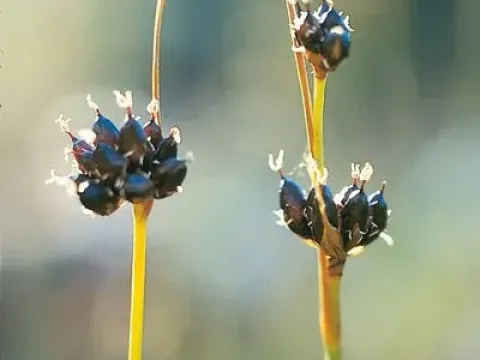
Chestnut rush
Juncus castaneus
Chestnut rush (Juncus castaneus) is a perennial herbaceous plant belonging to the Juncaceae family. It is a moisture-loving species that thrives in wetland habitats and is well-adapted to high-latitude and high-altitude environments.
What the section contains
Chestnut rush
The plant is native to arctic and alpine regions across the Northern Hemisphere. It typically grows in tundra areas, wet meadows, along stream banks, and in poorly drained, boggy soils where other plant species often struggle to establish.
Biologically, it is characterized by its rhizomatous root system and stems that grow to a height of 10 to 40 centimeters. The plant is easily identified by its terminal clusters of dark chestnut-colored flowers, which provide it with its common and scientific name.
In terms of soil and climate, the chestnut rush requires a cool climate and consistently wet conditions. It performs best on acidic or neutral organic soils. It is highly tolerant of frost, which is essential for survival in its cold native distribution range.
While the chestnut rush is not cultivated as a primary agricultural crop, it remains an important ecological component in natural pastures. It provides structural integrity to peat-based soils and serves as a minor forage component in subarctic grazing lands.