
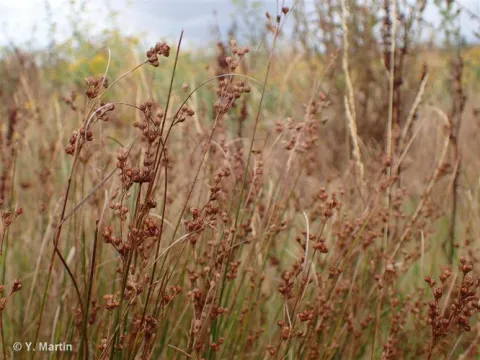
Fomin's rush
Juncus fominii
Fomin's rush (Juncus fominii) is a perennial herbaceous plant belonging to the Juncaceae family. This species is specifically adapted to wetland environments and thrives in areas with consistent moisture availability.
What the section contains
Fomin's rush
The native distribution of this plant includes moist habitats across Eastern Europe. It is commonly found in riparian zones, marshes, and damp meadows, where its biology is synchronized with high water table levels.
The species prefers organic-rich, silty, or peat soils with acidic to neutral pH levels. Its ability to withstand prolonged saturation makes it a valuable candidate for land restoration projects in areas prone to waterlogging.
Botanically, Juncus fominii features a sturdy stem structure and a deep root system. These adaptations allow the plant to stabilize loose soils, acting as a natural barrier against erosion along agricultural drainage channels.
Climatically, it is a hardy species capable of surviving freezing winters. It requires good exposure to sunlight and will typically decline if significantly overshadowed by taller encroaching scrub or riparian woody vegetation.
The agricultural utility of Fomin's rush is largely centered on its role in ecosystem services and specific technical applications. It is not typically classified as a high-value forage crop due to its structural composition.
Harvesting is usually conducted for non-food purposes, such as raw material for local crafts, mats, or natural mulch. In certain regions, its biomass is utilized in composting to improve soil structure and water retention.
The optimal time for cutting is early in the season, before the stems accumulate excessive levels of silica and lignin, which otherwise render the plant unpalatable to livestock and difficult to process industrially.
Harvesting methods are dictated by the challenging terrain. Because the species grows in wet, soft ground, specialized low-ground-pressure machinery is required to prevent soil compaction and damage to the local environment.
Future research is exploring the potential of Juncus fominii in bioenergy production, specifically its suitability for anaerobic digestion or as a feedstock for sustainable biomass heating applications.